

Most people use Claude like a hype machine.
Ask if the idea is good, get told it has potential, ship it anyway.
They are skipping the one system that could have saved them months of cleanup.

Save this before you lose it in your feed!
NASA does not let a rocket leave the pad on optimism.
Before every launch, every mission, every major call, they run a real, documented process to find the failure before the failure finds them.
It has a name. It has saved missions.
And almost nobody outside aerospace and high-stakes consulting knows you can run the same process inside Claude with 4 prompts.
No software. No clearance. No setup. Just paste.
5 minutes from now, you will know exactly how your plan dies, and how to stop it, before you spend a single dollar building it.
Claude is only as good as the system behind it. ClaudeKit gives Claude Code 121 slash commands, 25 skills, and 16 subagents across 6 specialized kits. One command installs a full working team.
→ Try it: theclaudekit.com
I learned this the hard way.
Eight months ago, I launched a paid product.
I had run it by three people I trust. Everyone said it looked strong. I shipped it.
It flopped in the first 48 hours.
Not because the product was bad.
Because I had assumed the wrong buyer. The exact assumption a premortem would have caught in 5 minutes.
I spent 6 weeks rebuilding what one structured question could have prevented.
That is what this issue is about.
Before I show you the 4 prompts, you need to understand why they work. This part is 60 seconds. It changes how you use everything below it.
What the ABORT Method Actually Is
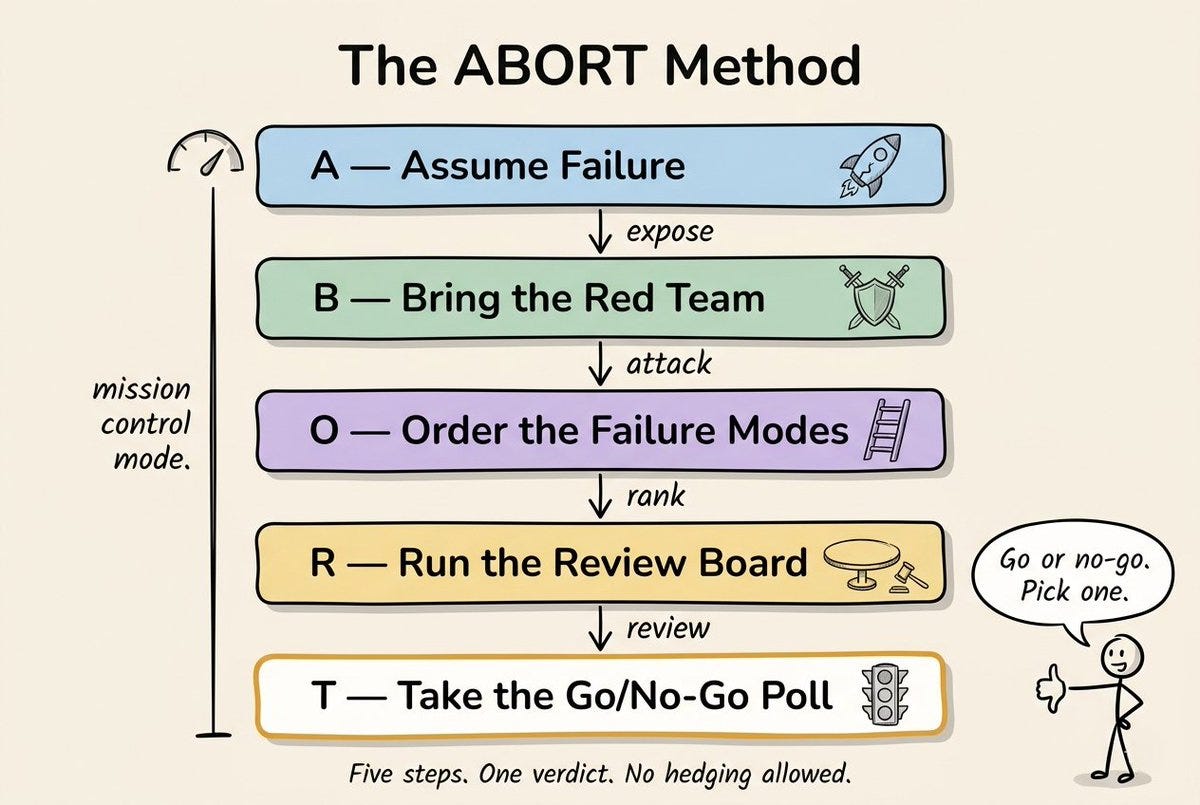
NASA runs two things before anything important happens.
A Failure Review Board, which exists specifically to hunt for the reasons a mission could fail before it flies.
And a Go/No-Go poll, where every station has to give a binary answer, out loud, on the record.
No hedging. No “should be fine.“ Go or no-go.
What is the ABORT Method?
That same instinct exists in psychology under a different name.
In 2007, cognitive psychologist Gary Klein published a method in the Harvard Business Review called the premortem.
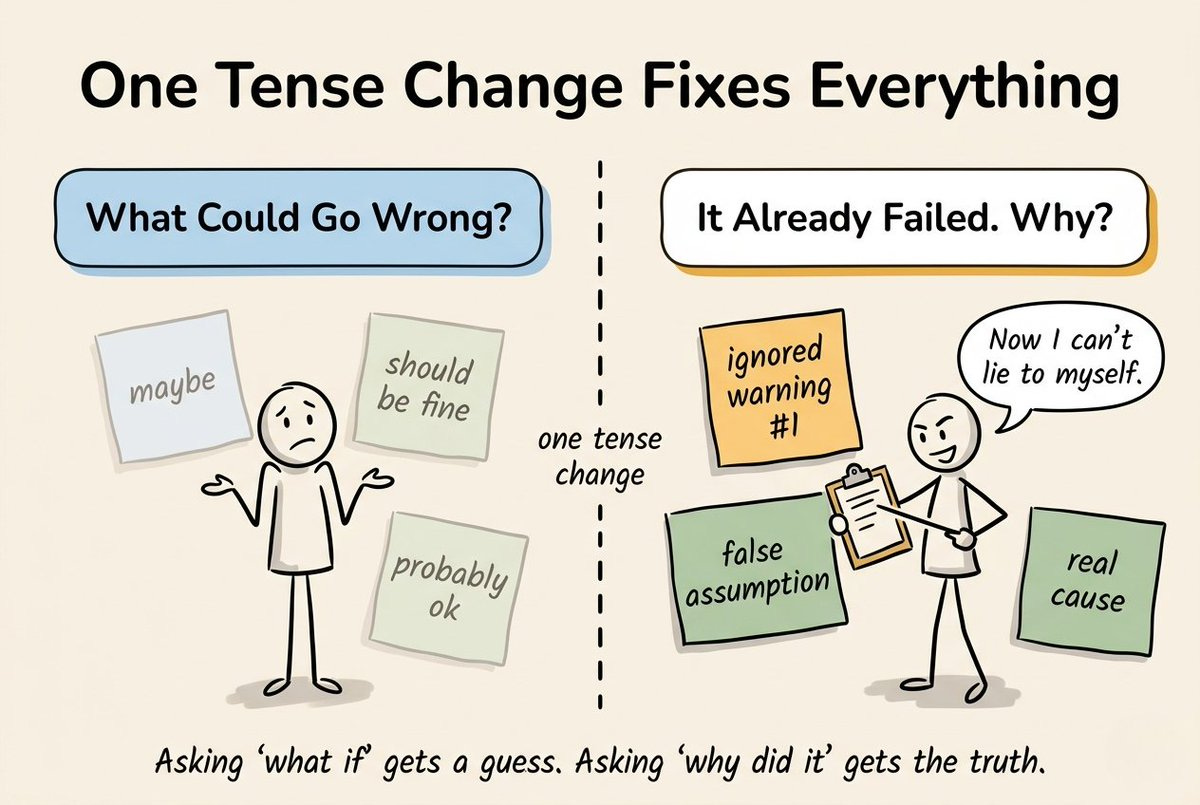
The idea: tell a team the project has already failed, one year from now, and ask them to explain why.
Not “what could go wrong.” What did go wrong? That single grammar shift, from maybe to already happened, is the whole trick.
It is not just a good idea. It is measured.
A 1989 study out of Wharton, the University of Colorado, and Cornell found that imagining a future event has already occurred increases people’s ability to correctly identify the real causes by about 30 percent compared to standard risk assessment.
Klein’s own follow-up research confirmed it again in 2010.
This is one of the most replicated findings in decision science, and most people have never used it on their own plans.
Here is the real prize.
You do not need a Wharton degree or a NASA badge.
The whole method is just a sequence of forcing functions.
You can run it inside Claude with 4 copy-paste prompts.
That is what the rest of this article is.
Why “What’s Wrong With This?” Will Always Fail
When you ask Claude, “Is this a good idea?” or “What should I watch out for?” you get the hedge. The “could go either way.” The “just make sure you.”
That is not analysis. That is politeness wearing a lab coat.
The reason a single prompt fails is the same reason a single risk assessment fails inside a real company.
Nobody wants to be the one who killed the room’s energy.
Devil’s advocate roles do not work either; researchers have found teams quietly dismiss them because everyone knows the criticism is assigned, not real.
The dissent gets outsourced to one voice, and everyone else relaxes.
NASA solved this with structure, not politeness.
Assume the failure already happened.
Assign people to attack the plan from specific angles.
Force every station to give a yes or no, on record.
The structure does the uncomfortable work, so no single person has to.
The four prompts below rebuild that exact structure inside Claude.
Prompt 1: The Premortem
This is the grammar shift that does 80 percent of the work.
Paste this into Claude.
Replace the plan in line 1.
My plan is: [YOUR PLAN, PROJECT, OR DECISION].
It is one year from now. This plan failed completely.
Not "could fail." It already happened.

Write the internal post-incident report as if you are
the project lead explaining the failure to leadership:

1. What was the ACTUAL cause of failure? Not the symptom,
the root cause underneath it.
2. What were the three early warning signs that were
visible at the time but got ignored or rationalized?
3. What assumption did the team treat as fact that turned
out to be false?
4. Who or what got blamed publicly, and what was the
REAL cause that the public blame was covering for?
5. What is the one sentence that, if someone had said it
out loud in the planning meeting, would have stopped
this entire failure?
What comes back: a forced confession your brain would never volunteer if you asked it to brainstorm “risks.” Asking for risks produces a polite list.
Asking for the autopsy of a failure that already happened produces the thing you were actually avoiding looking at.
A quick note from me:
The prompts in this issue are powerful.
But if you are using Claude Code for real work - content, engineering, SEO, ecom- you need more than prompts. You need a system.
ClaudeKit is 6 kits I built to give Claude Code a full team.
Type /mkt humanize and it strips every AI tell from your copy.
Type /eng debug and it roots the issue with evidence.
121 commands. Installed in under 5 minutes.
