

Imagine firing 4,000 people, telling the world AI replaced them, then quietly rehiring for the same roles 8 months later.
That’s not a hypothetical.

That’s what’s happening across corporate America right now.
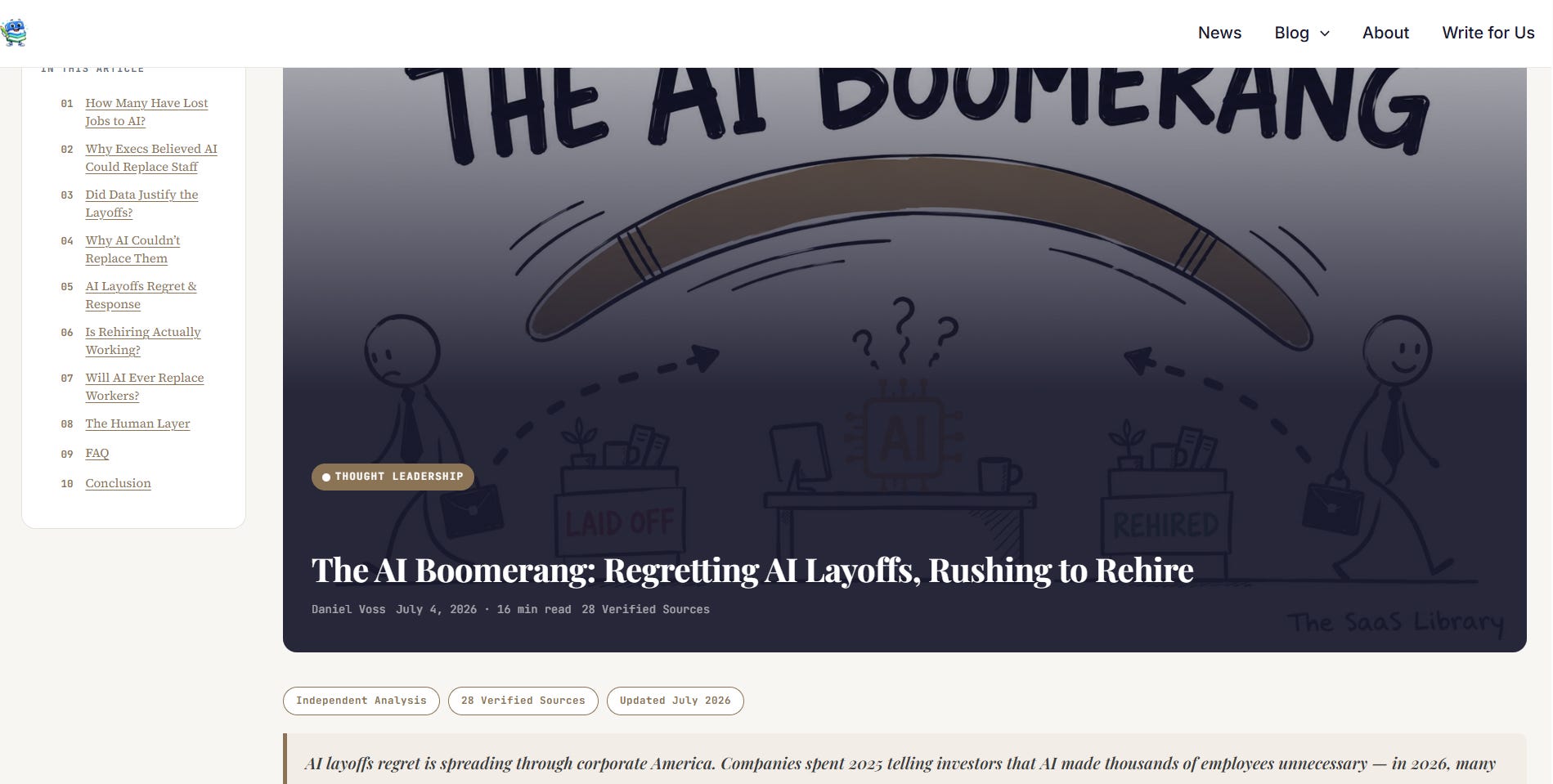
They’re calling it the AI boomerang.
Companies fired workers for AI, discovered AI couldn’t do the job alone, and are now scrambling to hire humans back.
And buried inside this corporate embarrassment is the single most important lesson about how AI actually works.
A lesson you can use today, without firing anyone.
By the end of this issue, you will get an AI Amplifier Audit: a Notion-ready framework that sorts every task in your business into three buckets (hand it to AI, pair with AI, keep human), with copy-paste prompts for each bucket. It’s the exact system the “regret-free” companies in this data used, scaled down for a team of one.
THE AI VAULT IS OPEN
Every guide, kit, template, and prompt library I’ve built - in one place. Organized. Searchable. Growing every week. Here’s how access works:
Paid Members: Get one specific guide related to the newsletter from the Vault every issue. Yours for a week.
Founding Members: Full access to everything inside the Vault. Every guide. Every kit. Every drop. Forever.
We’re 2-3 months away from 10K+ subscribers. The moment we hit that number, we’re launching a private free community - exclusively for AI In Public readers.
By the end of this issue, you’ll be able to look at any task in your business and know, in seconds, whether AI should own it, assist it, or stay away from it.
That’s the skill the companies in this story didn’t have.
It’s the skill that separates people who get amplified by AI from people who get burned by it.
This isn’t my opinion. This is what the data says.
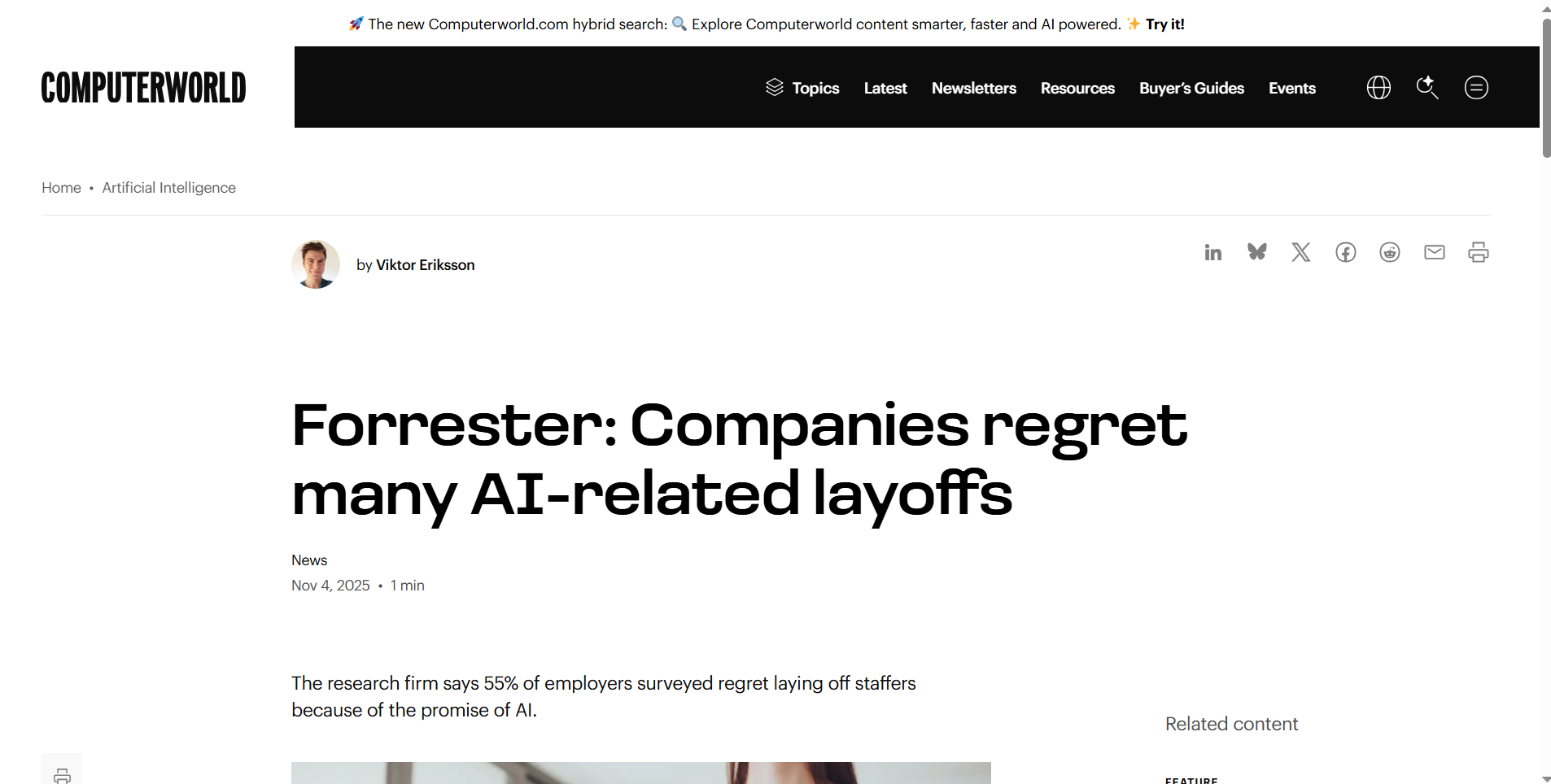
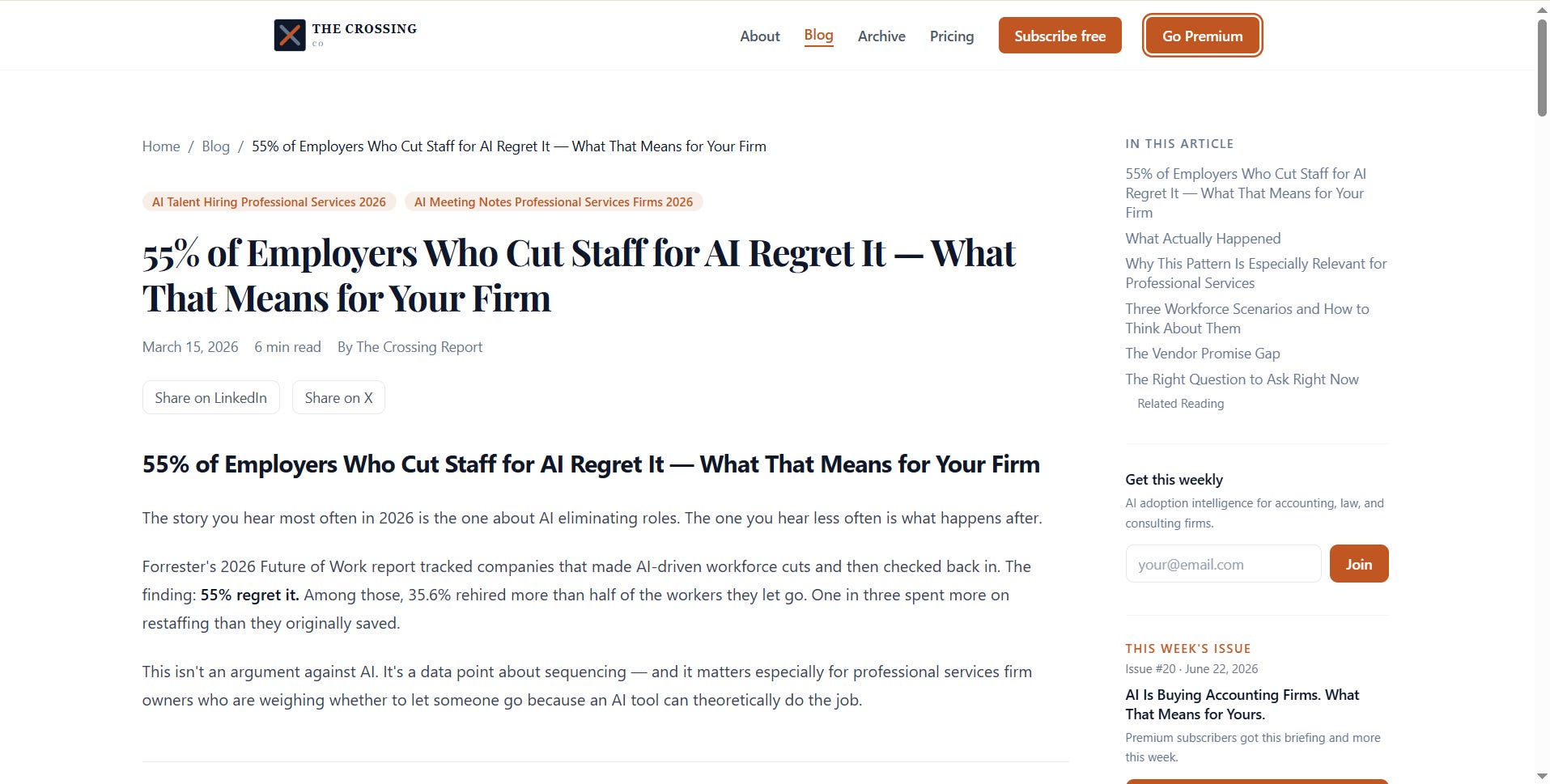
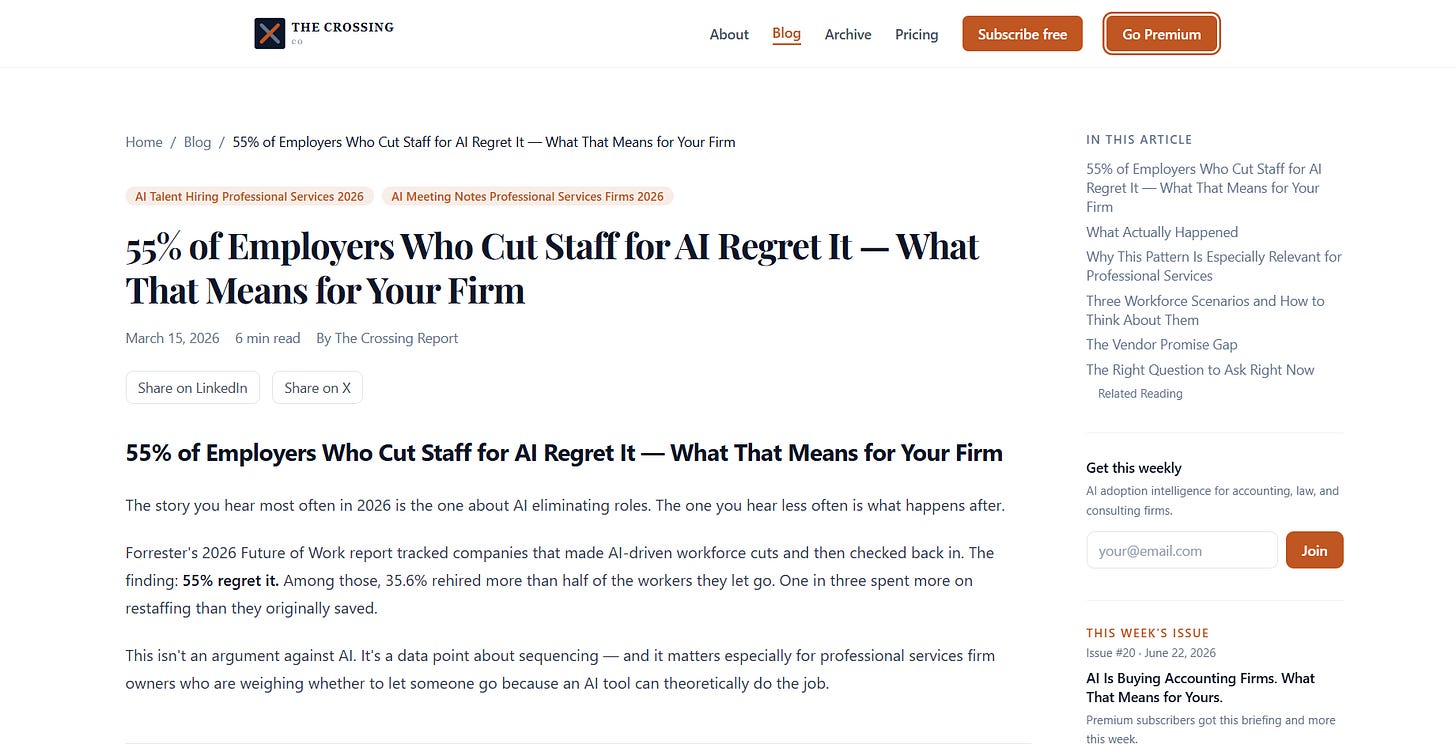
Forrester’s Predictions 2026 report found that 55% of employers who laid off workers for AI now regret it.
Orgvue ran a completely separate survey and landed on the same number: 55% of business leaders admit the redundancies were the wrong call.
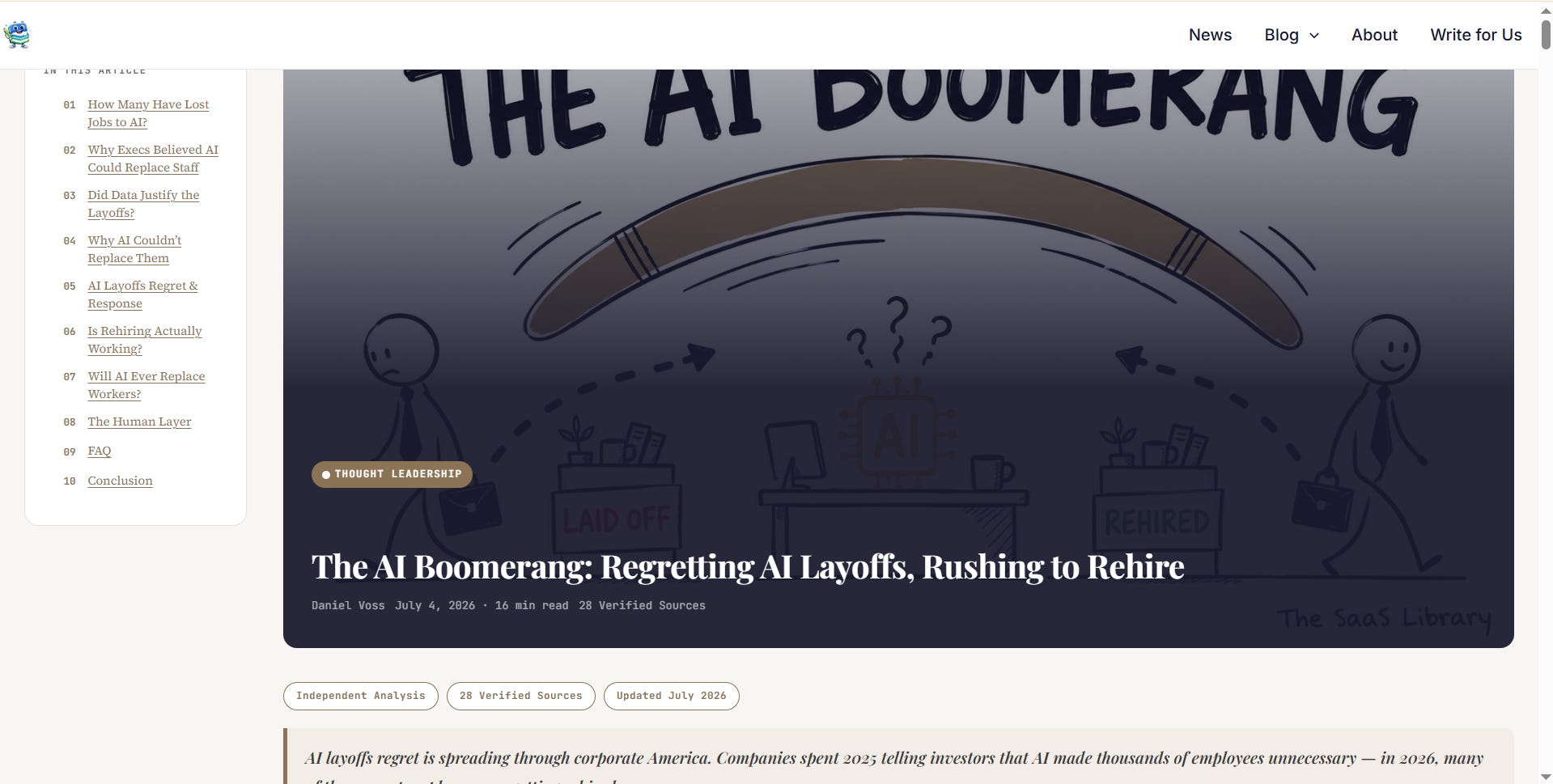
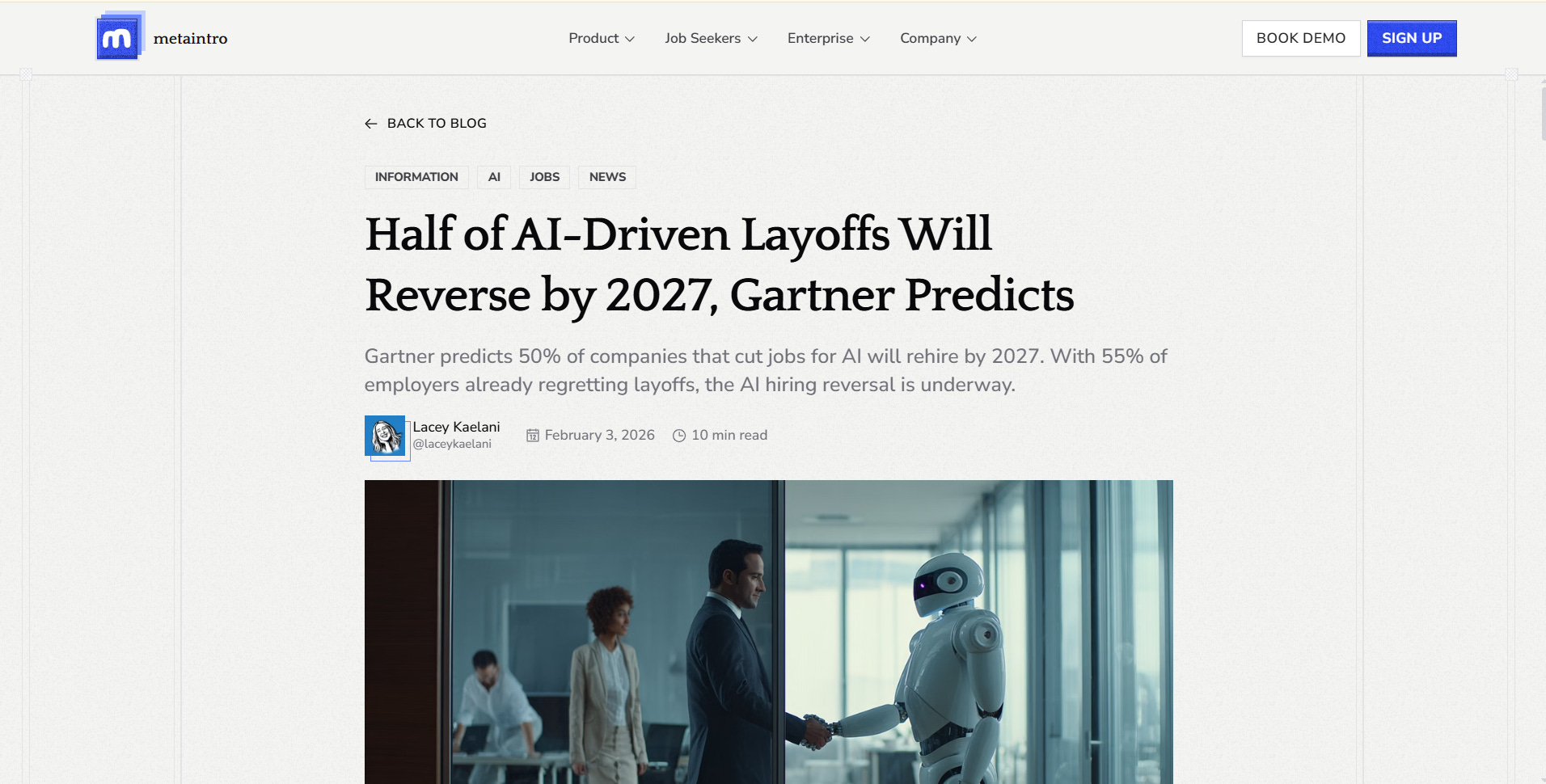
Gartner predicts that half of all companies that cut jobs for AI will rehire for those same roles by 2027.
Robert Half found that 32% of organizations have already rehired positions AI was supposed to fill, with finance leading the reversal at 44%.
But the stat that should make you stop scrolling comes from Harvard Business Review. They surveyed over 1,000 executives and found that 60% cut headcount in anticipation of AI. Only 2% cut based on AI actually performing the work.
Read that again. 60% fired for a promise. 2% fired for a result.
OLD WAY vs NEW WAY
Old way: AI can do this job → fire the human → save the salary
New way: AI can do 60% of this job → keep the human → they now do the work of two
The companies drowning in regret picked the old way.
The companies with zero regret in Forrester’s data picked the new way: they used AI to expand capacity, kept their people on the judgment work, and let AI eat the volume work. Revenue went up. Costs didn’t significantly change. Margins improved.
Sound familiar? That new way has a name. It’s called being a solopreneur with AI.
You never had headcount to cut.
You were forced into the amplify model from day one.
Congratulations: the Fortune 500 just spent billions discovering your business model is the correct one.
STEP-BY-STEP WALKTHROUGH - Why the Replacements Failed (and What Actually Works)
Step 1: Understand where AI breaks.
Klarna is the cautionary tale.
They replaced the workload of roughly 700 customer service agents with an AI chatbot and bragged about it publicly.
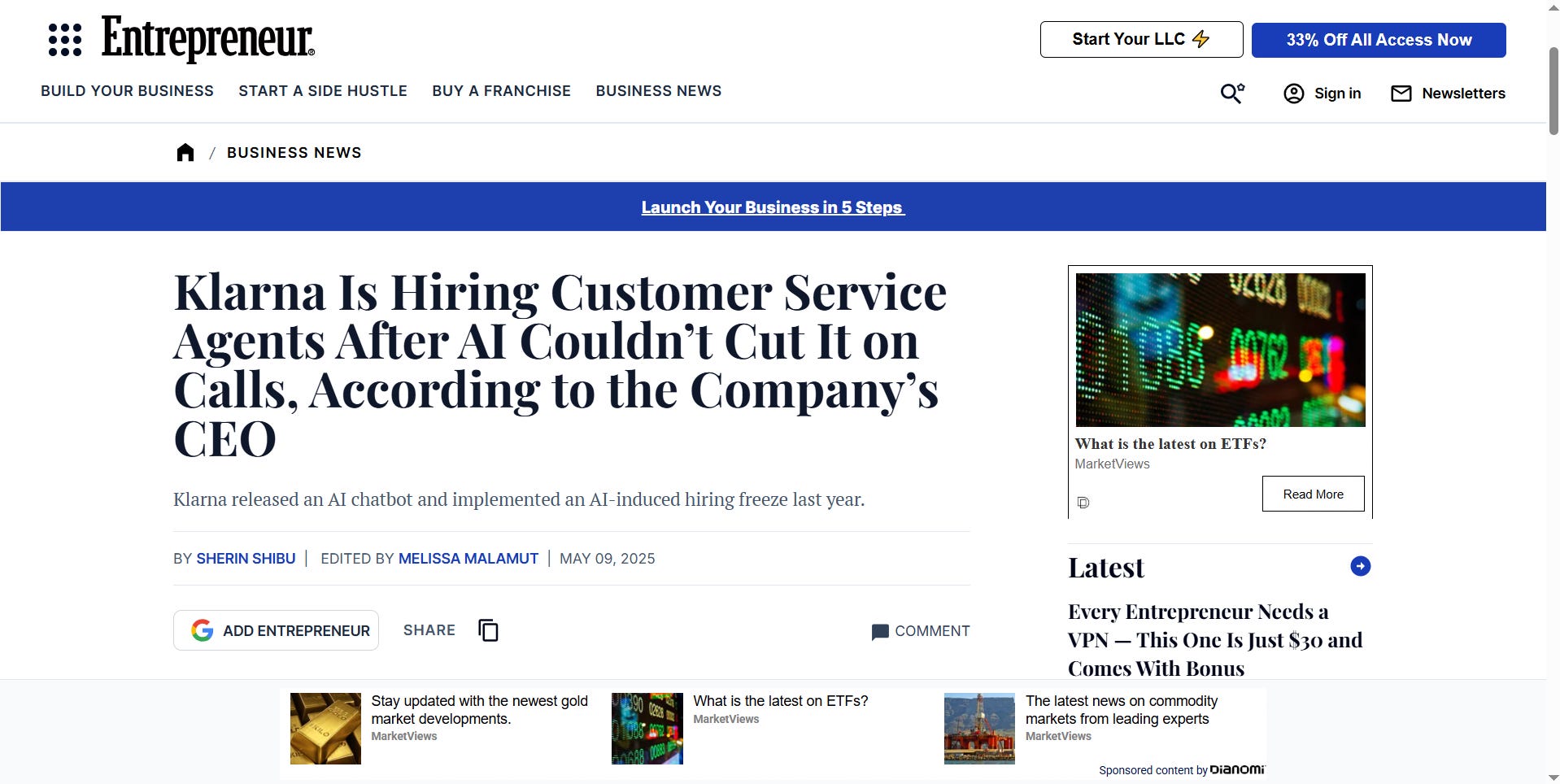
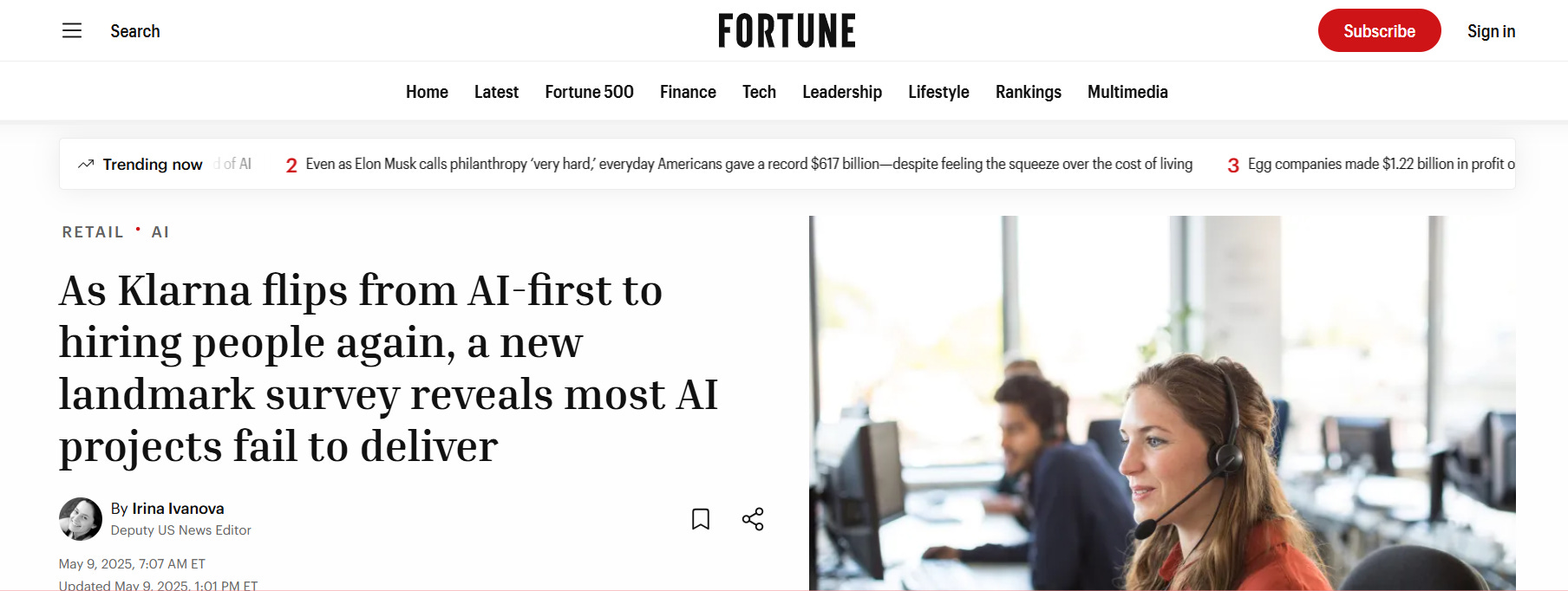
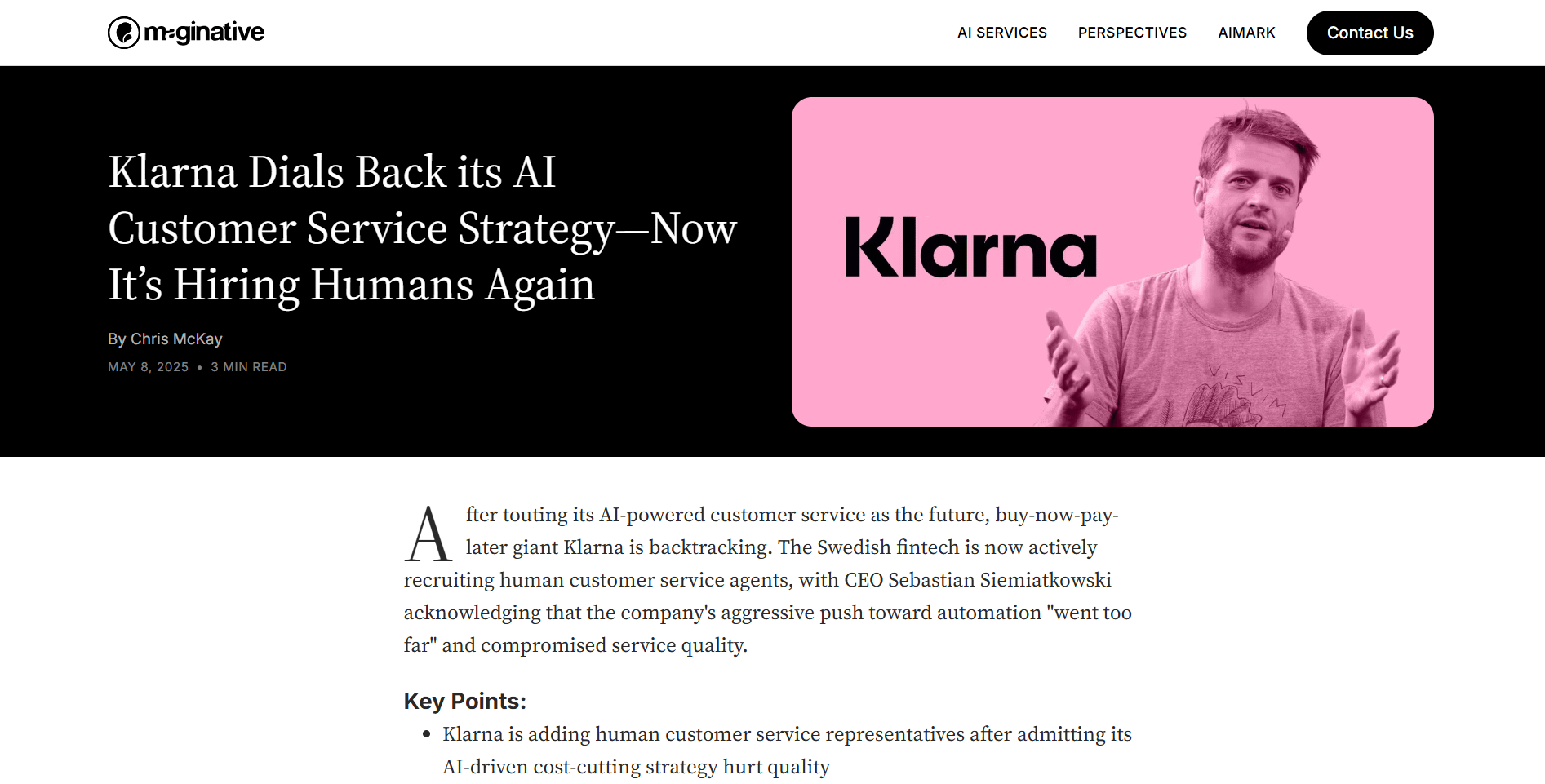
Then quality collapsed, customers revolted, and CEO Sebastian Siemiatkowski told Bloomberg the company “went too far” and that cost focus produced “lower quality.”
Tech analyst Gergely Orosz actually tested the chatbot early on and called it “underwhelming,” noting it just recites docs and passes you to a human. The narrative cracked before Klarna admitted it.


They’re rehiring. They’re calling it an “Uber-style” customer service model now. Different words, same outcome: humans are back.
The pattern in every failure is identical. AI handled routine volume fine, then face-planted on the cases that needed judgment, empathy, or context. IBM’s AskHR system resolved 94% of routine requests. The other 6% is why they rehired.
Step 2: Notice which work came back to humans.
Robert Half’s data shows finance rehiring fastest at 44%, then HR at 35%. The most judgment-heavy functions boomeranged hardest. Transcription didn’t come back. Scheduling didn’t come back. Trust decisions, edge cases, and relationships came back.
Step 3: Map the split in your own business.
Every task you do this week falls into one of three buckets:
→ Volume work: repetitive, high frequency, low judgment. Research summaries, first drafts, data cleanup, formatting. AI owns this.
→ Judgment work with volume underneath: writing that sounds like you, client proposals, strategy. You lead; AI assists.
→ Trust work: pricing decisions, difficult client conversations, final quality checks. Human only. Every failed company in this story automated this bucket.
Step 4: Run the test I ran.
Pick one task from bucket one. Give it fully to AI for one week. Fact-check everything the first three times. If the error rate is near zero, it stays delegated. If you’re spending more time fixing than it saved you, it moves up a bucket.
That last sentence is the entire lesson the boomerang companies skipped.
This bucket system is exactly how I structured ClaudeKit. Every slash command in the kit is a bucket-one task: pre-tested, delegated, near-zero error rate, so you never burn an afternoon debugging AI output. It’s the difference between using AI and being amplified by it. → theclaudekit.com
BEST PRACTICES / USE CASES
Do this:
Delegate tasks where a mistake costs you minutes, not clients
Keep a “hallucination log” for the first month. Note what AI gets wrong and where. Patterns emerge fast.
Re-audit your buckets every quarter. Models improve. Last year’s bucket-two task might be bucket-one today.
Never do this:
Delegate anything customer-facing without a human check. That’s the exact Klarna mistake at solo scale.
Judge AI on the demo. Judge it in week three, on your real messy data. Forrester calls the gap between the two “the vendor promise gap.” It’s where the 55% got burned.
Assume “AI did it faster” means “AI made you faster.” If review time eats the savings, you lose.
Share this and get rewarded
Go to AI In Public → scroll to the Leaderboard section → copy your referral link → share it with anyone.
Every signup through your link moves you up the board and unlocks real rewards.
At the end of every month, we check the leaderboard.
The top 3 get our best guide - DMed directly, no opt-in required.
REAL-WORLD EXAMPLES
The failure at scale: Salesforce cut roughly 4,000 support roles. Months later, CEO Marc Benioff admitted AI handles about half of customer conversations. Humans still carry the other half. They announced the layoff louder than the rehiring.
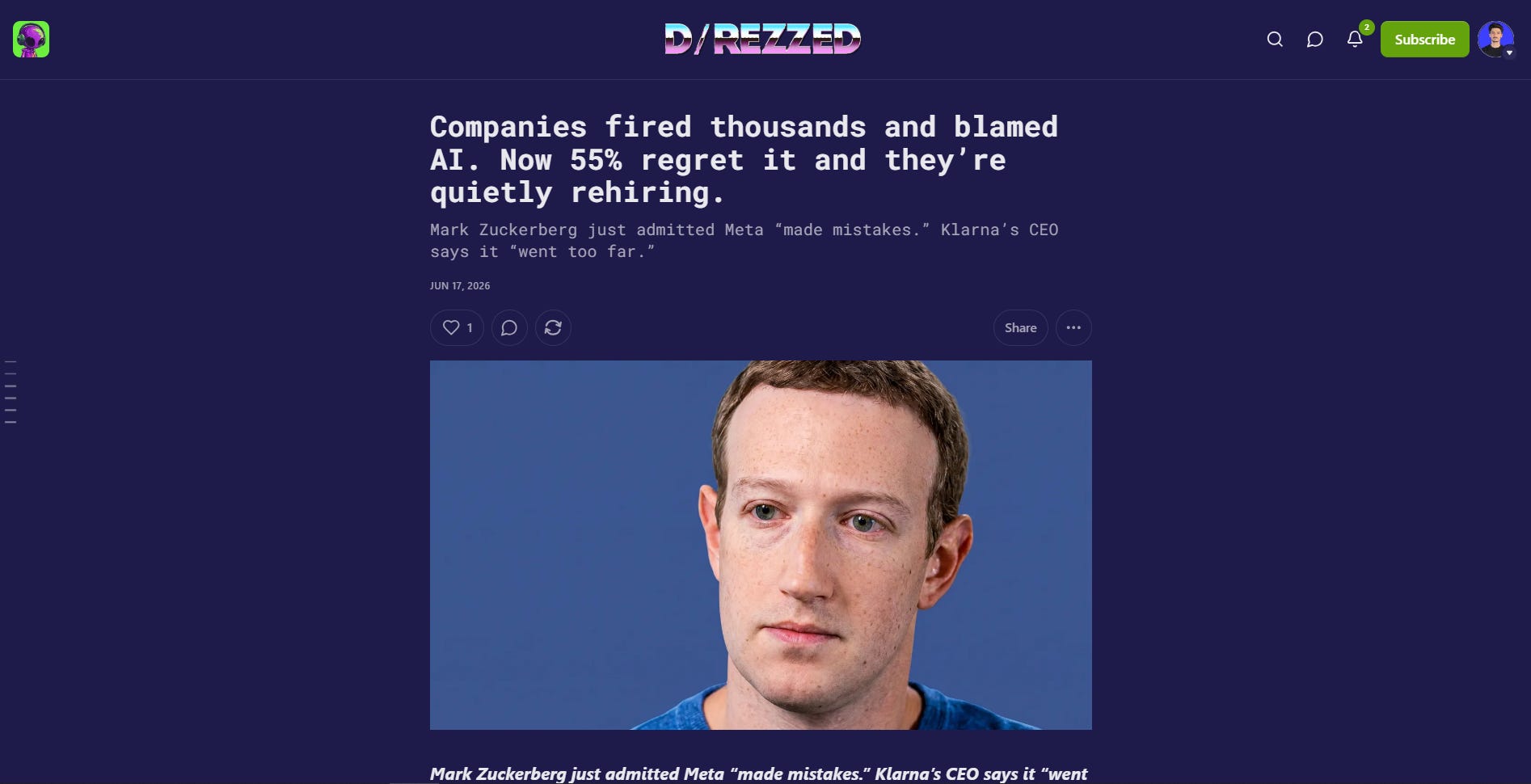
The failure admitted: Meta’s Zuckerberg apologized in an internal memo for how a restructuring hitting roughly 20% of the workforce was handled, saying the company “made mistakes and will almost certainly make more.”
The quiet winner: The regret-free firms in Forrester’s data share one trait. They added AI to each person’s workflow, tracked the recovered hours, and grew revenue without cutting a single role. One person doing the work of two beats two empty chairs and a chatbot.
The market punishment: Goldman Sachs found that stocks now drop about 2% on average after AI-attributed layoff announcements. The market stopped rewarding the hype.
Slow down for a second.
If you’ve ever felt behind because you’re “just one person” competing against funded teams: this issue is your receipt.
The funded teams bet billions that AI replaces people.
They lost.
The model that won is one human with good judgment, amplified by AI on everything else.
You’re not behind. You’re early to the model they’re now crawling back toward.
55% of employers regret AI layoffs (Forrester and Orgvue, independently)
Half of AI-attributed layoffs will reverse by 2027 (Gartner)
60% of execs cut for AI’s promise. Only 2% cut for AI’s performance (HBR)
AI fails at judgment, empathy, and edge cases. It wins at volume.
Run the three-bucket audit on your own task list this week
Never delegate trust work. Ever.
Upgrade to keep reading
The free version of this newsletter gets you the what.
Paid members get the how, in detail.
Every issue comes with a resource that took me hours to build and takes you 10 minutes to use.
Paid Members: One hand-picked AI Vault guide every issue, chosen for what we covered today.
Founding Members: Full AI Vault access. Every guide. Every kit. Forever. Plus, first access to the private community at 10K subscribers.
Everything above is free. What’s below is for paid subscribers.
