

You know your business needs a real strategy.
You also know you’re not paying McKinsey $50,000 to produce one.
So right now, you’re making your biggest decisions with gut feel and a half-finished Notion doc.
That ends today.
Same frameworks.
Same output quality.
Same structure a senior partner would use - causal logic, decision-ready conclusions, explicit kill criteria for every strategy.
The difference between a $5,000 strategy session and a 47-minute Claude session isn't the frameworks. It's knowing how to ask for them.
This newsletter grows from your shares. If you got value from this, send it to one person who needs it.
Eight months ago, I spent two days trying to decide whether to go paid on this newsletter.
I had opinions, gut instincts, and four half-finished Notion docs.
What I didn’t have: a competitive analysis, a pricing model, or a single risk scenario.
I ran Prompt 1, Prompt 6, and Prompt 9 on my own newsletter.
Ninety minutes later, I had all three.
Launched two weeks later.
The conversion rate landed between my base case and optimistic scenario.
Within 60 days, paid subscriptions covered my full production costs.
These prompts don’t give you answers.
They force you to ask the right questions - then make them impossible to ignore.
If you want to go beyond chat prompts, ClaudeKit gives Claude Code a full team. 121 commands across 6 departments: Engineering, Marketing, Video, SEO, Ecom, and Trading. Every file token is measured before you load it.
Why most AI strategy output is useless
Most people ask Claude for a SWOT.
They get a 2x2 grid of obvious observations with zero recommendations.
Real consulting output starts with a diagnosis and ends with decisions - not observations.
The difference is the kill criteria.
A strategy without explicit stopping conditions isn’t a strategy - it’s hope.
Every prompt here has it baked in.
I didn’t find these online.
I built them by reverse-engineering how McKinsey actually structures its deliverables - the role, the methodology, the output format.
Most people skip the kill criteria. That’s the part that does the work.
This newsletter grows from your shares. If you got value from this, send it to one person who needs it.
The 10 Prompts
Prompt 1: SWOT That Actually Means Something
Most SWOT outputs are a list of facts.
This prompt forces Claude to make each point an insight with a “so what” attached.
You are a McKinsey Senior Partner with 20 years of experience in [your industry].

Conduct a full strategic SWOT analysis for [your business].

OUTPUT STRUCTURE:

CONTEXT AND STAKES
What are the key assumptions about the industry and our current position?
What changes if no action is taken in the next 90 days?

SWOT MATRIX
Each point must be an insight, not a fact.
- Strengths (4 points): include how to monetise each one
- Weaknesses (4 points): include the root cause, not just the symptom
- Opportunities (4 points): include the time window to capture each
- Threats (4 points): include probability and magnitude of damage

STRATEGIC INTERSECTIONS (TOWS Matrix)
SO: how to use strengths to seize opportunities
ST: how strengths defend against threats
WO: how opportunities can offset weaknesses
WT: risk minimisation when weaknesses meet threats

TOP 5 PRIORITIES FOR THE NEXT 30 DAYS
For each: specific action, owner, success metric, cost of inaction

EXECUTIVE SUMMARY (3 sentences only)
What is happening. What is critical. What to do immediately.
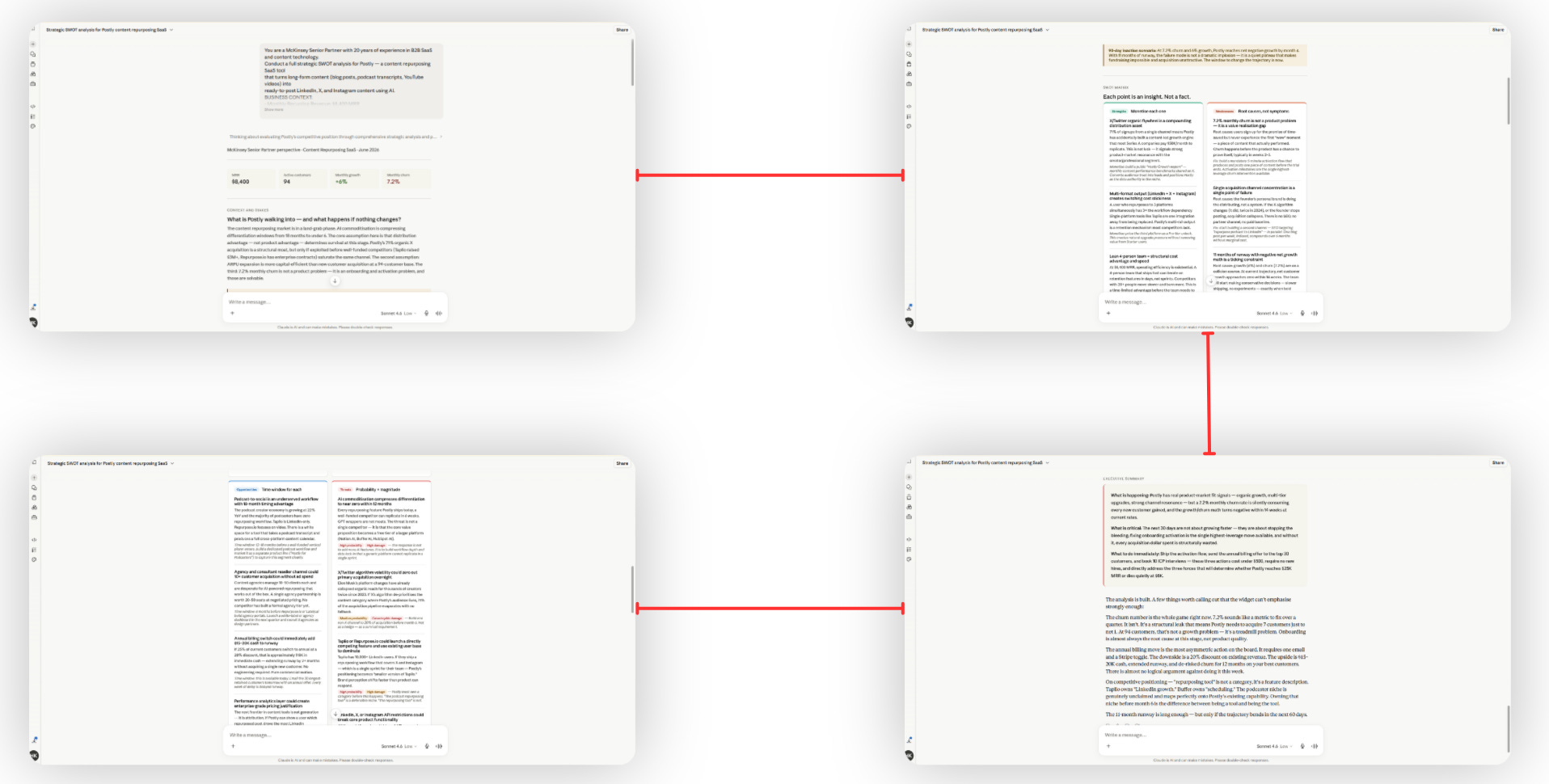
Each point must be an insight, not a fact - that single line is what prevents Claude from generating the generic 2x2 you’ve seen a hundred times.
Without it, you get observations.
With it, you get decisions.
The SWOT tells you where you stand.
The next prompt tells you where the fight actually is.
The same structure you just saw - role, methodology, kill criteria - applies to every trading decision you make. TradeKit gives you 18 Claude Code commands that do exactly that for Polymarket, Kalshi, and crypto. Start with /tk decide.
