

You opened Claude this morning and used it to write one email.
That’s like buying a factory and using it to sharpen a single pencil.
I’m not exaggerating.
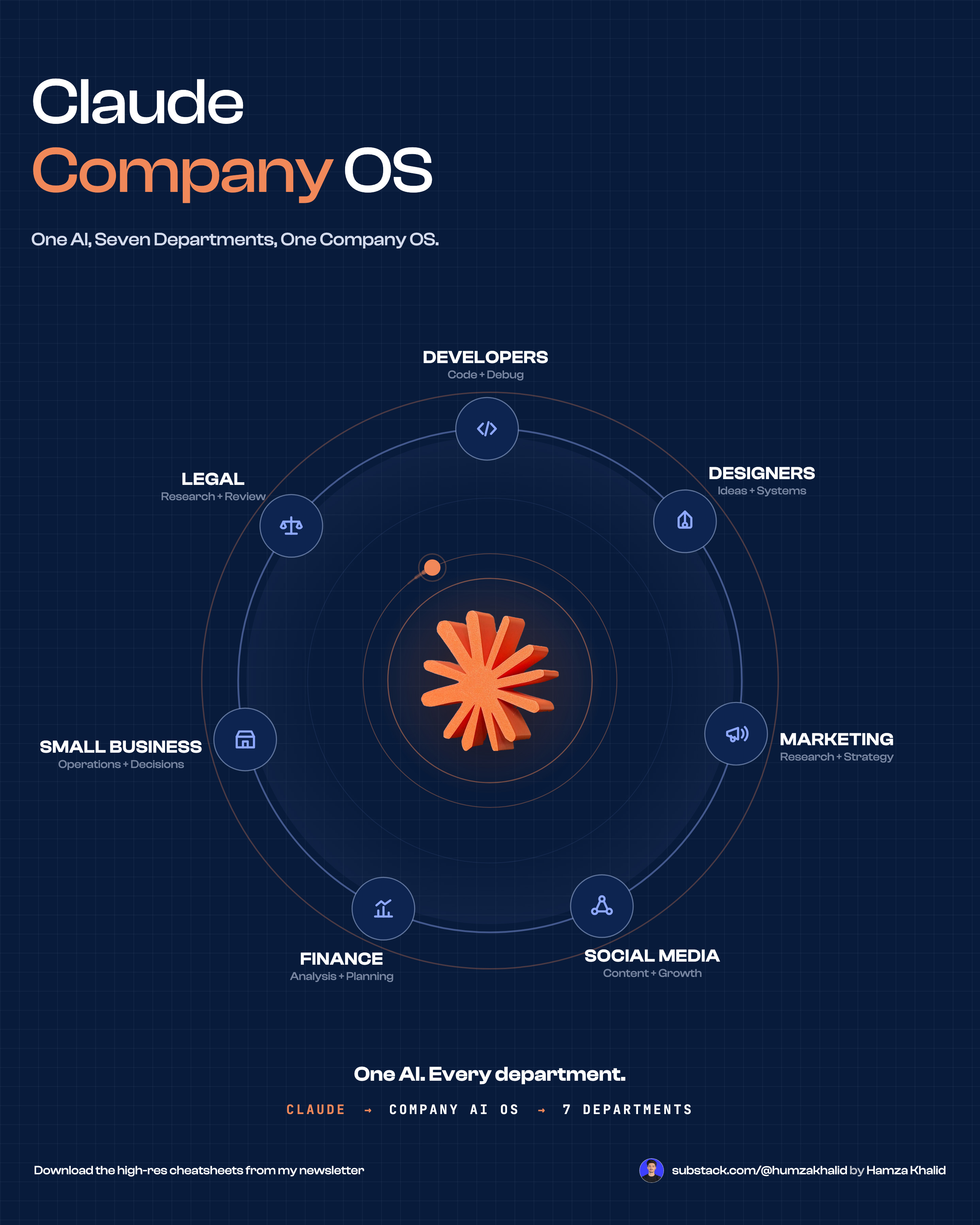
The thing sitting in your browser tab right now runs my engineering, my design, my marketing, my social, my finance, my ops, and my legal review - from one workspace, on call every hour of the day, for the price you’re already paying.
Most people never see it.
They treat Claude like a chatbot instead of a company.
How to Use Claude Better Than 99% of People

You are sitting on a Ferrari and driving it like a bicycle.
Today I fix that. Permanently.
And I am not going to describe it in theory. I am going to open my actual Marketing operator in front of you, and hand it a real task.
You will watch it produce finished work with my voice, my rules, and my checklist already inside it - work I never re-briefed.
By the end of this issue, you get the exact setup: all seven departments as SKILL.md files, all seven project-instruction briefs, the pull-work prompt pack, and the “how I actually do the work” template
Let me show you how it works.
Go check my work first
Before you read another line, do this.
Open my Substack. Scroll my last twenty issues. Look at the consistency - the voice, the structure, the way every issue lands the same way.
That consistency is not discipline. I do not have that much discipline.
It is a Claude Project doing its job while I sleep.
The part I never talked about
Here is the honest version.
For months I ran my business the way you probably run yours. Eleven tabs open.
One for writing.
One for a design tool.
One for a “SEO assistant.”
One for invoices.
A Notion doc of prompts I kept re-pasting into fresh, amnesiac chats.
Every task meant re-explaining my entire business from scratch to a chatbot that forgot me the second I closed the tab.
The loop was slow. But slow was not the real problem.
The real problem was the forgetting.
Every new task started from zero.
The rules I set on Monday were gone by Tuesday.
The voice I corrected last week never carried into this week.
I was not building anything. I was re-briefing the same intern, forever.
That is the exact broken-memory trap I broke down here, if you want the deeper diagnosis:
Your AI Memory Is Broken if you are missing this one hack.

I’ve sent Claude the same instruction 47 times this year.
So I stopped trying to prompt faster.
I built a system that remembers instead.
Where this actually put me
This is not a thought experiment.
Running Claude as a company OS is how I ship three newsletter issues a week, publish across four platforms, and still close my laptop before dinner - as one person.
The leverage did not come from working faster.
It came from never re-explaining the work.
The system remembers. I just decide.
By the end of this issue, you will not have “an AI subscription.”
You will have an operating layer. You will open one workspace and say “draft the launch page,” “chase the unpaid invoice,” “review this NDA,” “script the reel” - and each request lands with an operator who already knows your standards, your voice, and your rules.
That is the shift from user to operator.
The task is the deliverable. The operator is the asset.
Old way. New way.
The old way: Open a fresh chat, re-explain your business, paste your prompt, get generic output, fix it by hand, repeat tomorrow from zero.
The new way: Open your workspace, say the task in plain English, the right operator loads itself with your voice and rules already inside, get on-standard output, ship.
Most people use AI to make one task faster. That is the small version.
The bigger version is building a thing that runs every future task for you, and gets sharper every time you use it. It is the same principle behind running an entire company as one person:
How to Build $1B/ 1 Person Company Using AI

Most people think a one-person company means doing everything yourself.
If this is useful, share it with one person who still re-explains their business to a chatbot every morning. Takes 10 seconds.
Everything above is the what. Below the line is the how.
The full seven-department system. The real Marketing operator, built live. The four moves. The delegation prompts. The failure that taught me the whole thing.
Free readers stop here with a nice idea. Paid readers close this tab with a company OS.
Paid members get the whole thing, done:
All seven departments as
SKILL.mdfilesAll seven project-instruction briefs
The pull-work prompt pack
The “how I actually do the work” template
HOT OFFER
For the next 14 days, founding members get in for $200 instead of $300 - 33% off, locked in for life.
