

You lost the 9 AM argument again.
Two lines written. Then you went to answer emails nobody needed answered.
“I’ll write it after lunch.”
“I need to research this first.”
“Not in the right headspace today.”
You are not lazy. Your brain is doing what it evolved to do: avoid discomfort, save energy, fight tomorrow.
I have built AI systems for three years and taught 150,000 people to use them. I still lose that 9 AM argument. So this is not about discipline. It is about tricking your brain into hard things, with AI on your side of the table.
By the end, you will get all seven prompts, copy-paste ready, plus a “Which Prompt Right Now” router and a tracker. It is at the bottom.
Your brain resists hard tasks for two reasons.
The task feels emotionally expensive, and the task threatens your self-image. AI does not remove the work. It shrinks the distance between you and the first move.
Seven prompts below, each aimed at one form of resistance. Every one ends with you doing something offline inside five minutes. If you use only one, use the first.
By the end of this, you stop trying to win the whole day. You win the first ninety seconds instead. Every morning, the same small move, too small to argue with. The draft that scared you becomes the draft you already started. Not because you found more discipline. Because you stopped needing it.
THE ROOM OPENS AT 500 PAID MEMBERS
At 500 paid subscribers, the private Discord opens. Not a dead channel - a working room where you drop the task you’re avoiding or the problem you're facing and get the solution that unsticks it from people doing the same work or a solution to the problem.
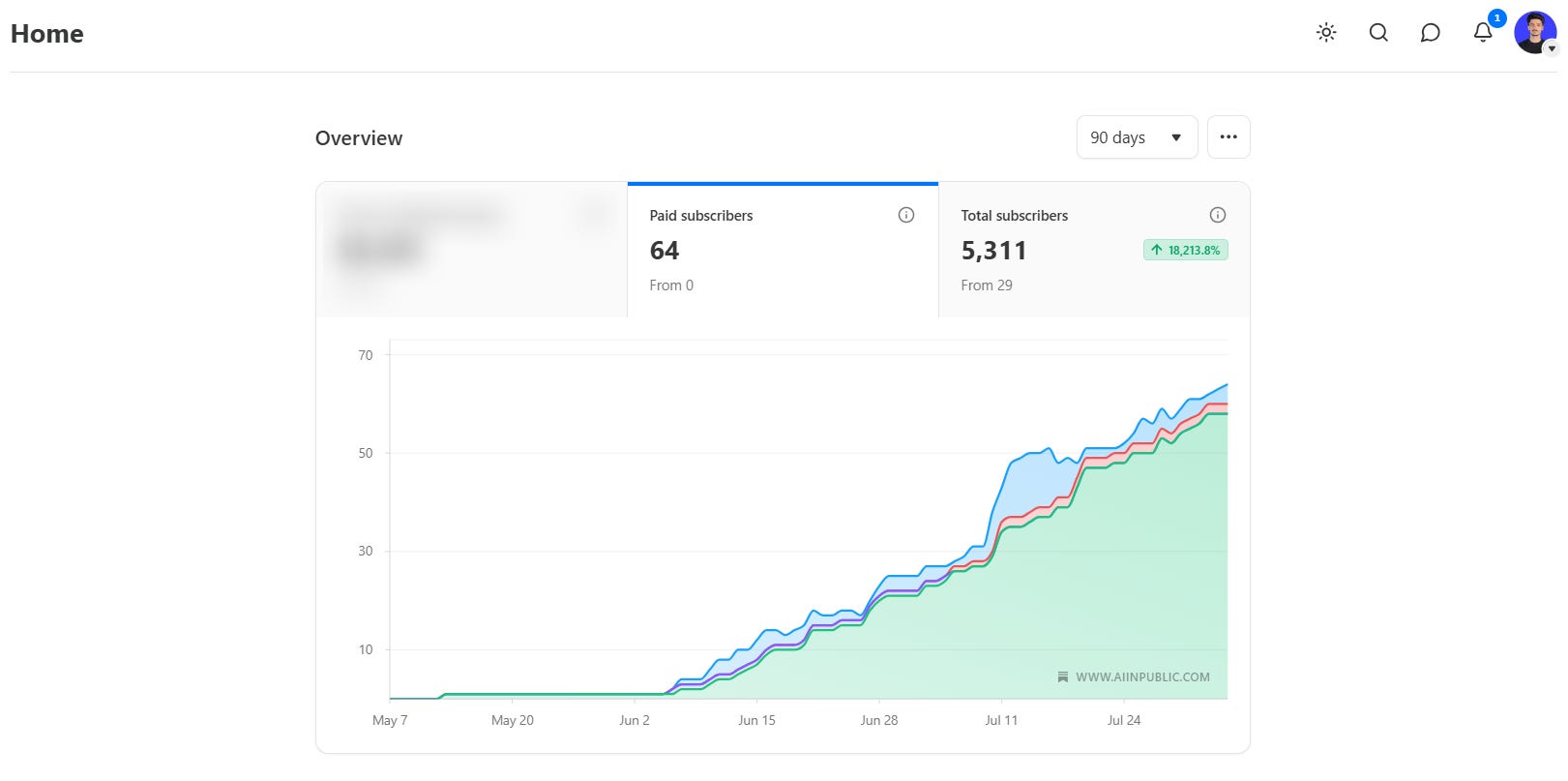
We’re at 64 paid subscribers right now. Every upgrade is one seat closer.
Two Reasons Your Brain Fights You
Resistance shows up in two forms. Dr. Dominic Ng’s framing is the cleanest I’ve read.
Resistance 1: Emotional Pushback
Your brain doesn’t judge a task logically. It judges how the task feels - and the bigger the task looks, the bigger the feeling.
“Write the whole newsletter” → dread. “Write one ugly sentence” → fine.
“Learn AI properly” → overwhelming. “Try one prompt” → easy.
“Build the whole system” → paralysis. “Name the first file” → nothing at all.
Same work. Completely different emotional price tag.
Resistance 2: Ego Protection
The second kind comes from the story you tell yourself about who you are. Your brain protects that story before it protects your goals.
Believe you’re not technical, and the terminal feels hostile before you open it.
Believe you’re a perfectionist, and starting becomes the scariest part of the day.
Believe you’re behind on AI, and you avoid the exact thing that would catch you up.
The resistance was never about the task. It was about protecting the story.
For most of history, your only weapon against both was willpower - white-knuckling it and hoping there was enough in the tank. Now you have a machine that will sit with you at 6 AM and cut the mountain into a step you can take.
Which prompt to use when
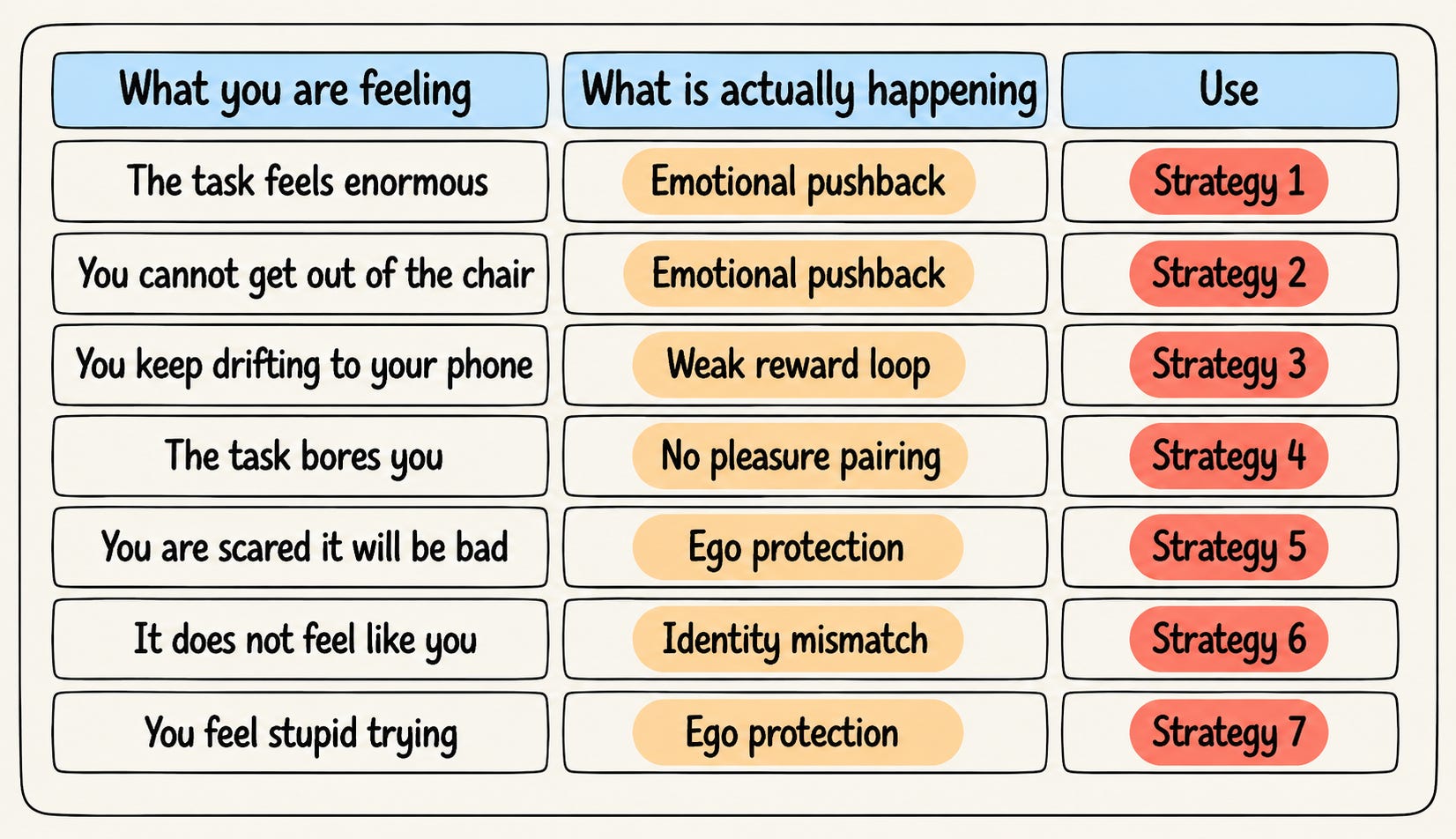
Save this table.
Strategy 1: Make AI shrink the task before you touch it
Dread → ninety seconds
Your brain resists the size of the thing. So stop negotiating with it. Hand it over first.
Purpose: turn one intimidating task into a first move so small that refusing it would feel ridiculous.
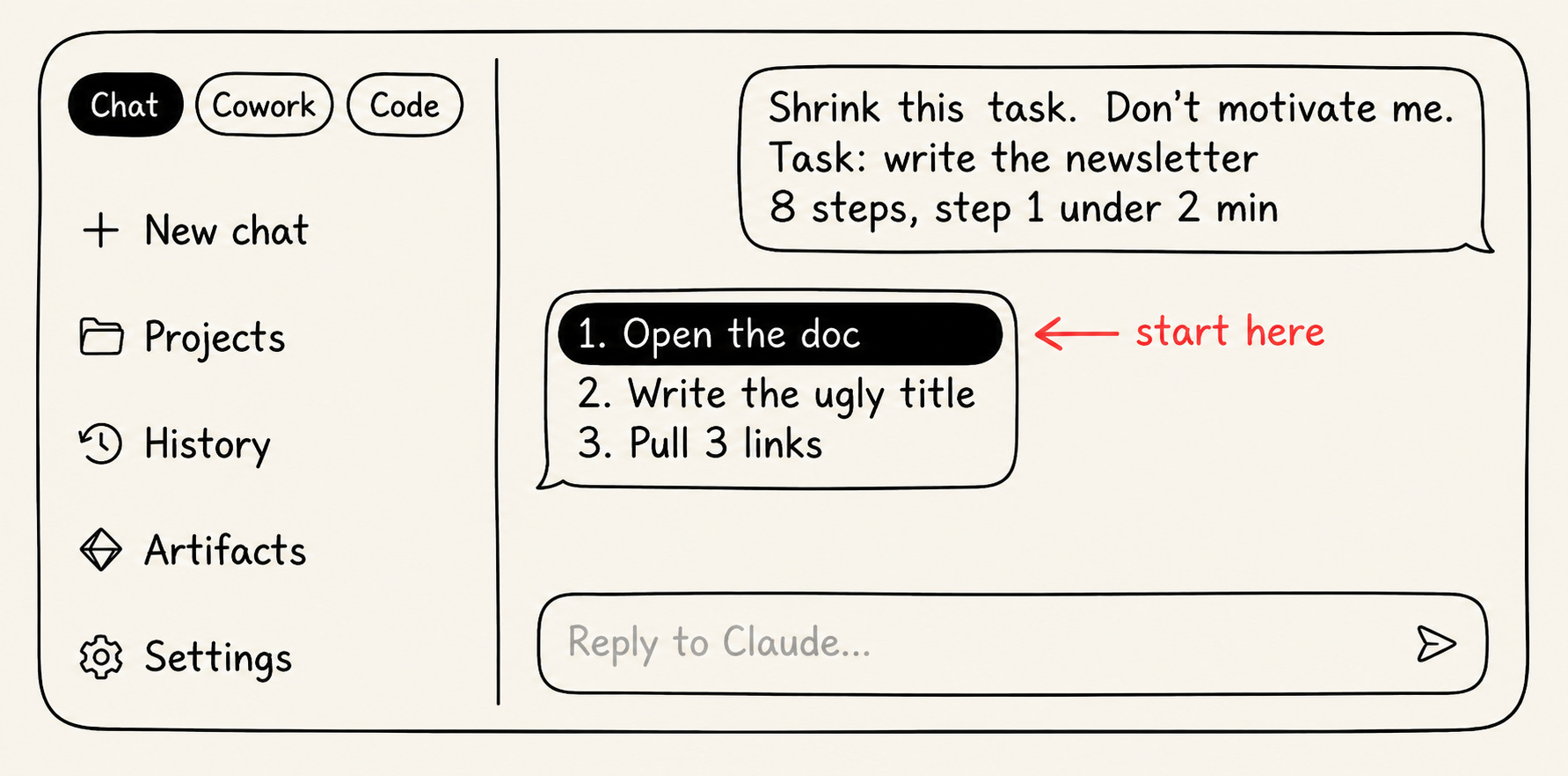
You are my task-shrinking assistant. Do not motivate me.
Task I am avoiding: [describe it in one messy sentence]
Deadline: [date] | Time I actually have today: [minutes]
Break it into 8 steps, ordered smallest to largest.
Step 1 must take under 2 minutes and require zero thinking.
Return only the numbered list. No intro, no encouragement, no summary.
The “do not motivate me” line matters more than you’d expect - pep talks wake the exact ego resistance you’re sneaking past. What comes back sounds almost stupid: open the doc, write the ugly title, pull three links. You’re not committing to the mountain. You’re committing to ninety seconds, and your brain won’t fight ninety seconds.
Strategy 2: Let AI do the setup so you only have to start
Blank page → tabs already open
Some days two minutes is still too much. That’s not a character flaw. That’s a Tuesday. So don’t start the task. Start the preparation.
Purpose: use physical movement to get past emotional resistance without touching the real work yet.
Act as my setup assistant. I am not ready to start the task yet.
Task: [X] | Where I am working: [laptop, desk, gym, kitchen]
List only preparation steps. Never the task itself.
Include files to open, tabs to close, notes to pull, and one thing to physically move.
Maximum 6 items, each one doable in under 60 seconds.
End with the exact first sentence I should type, or the first rep I should do.
That last line has research behind it. In 1999, psychologist Peter Gollwitzer showed that attaching a plan to a specific cue - an if-then - raises your odds of following through. The prompt writes that if-then for you. By the time the tabs are open, you have momentum you never had to manufacture. I do this before every long article now.
I do this before every long article now - it's one piece of the larger system I use to run the whole newsletter solo, which I broke down here:
How to Build $1B/ 1 Person Company Using AI

Most people think a one-person company means doing everything yourself.
Strategy 3: Build a Reward Loop
Rewards you steal → rewards you earn
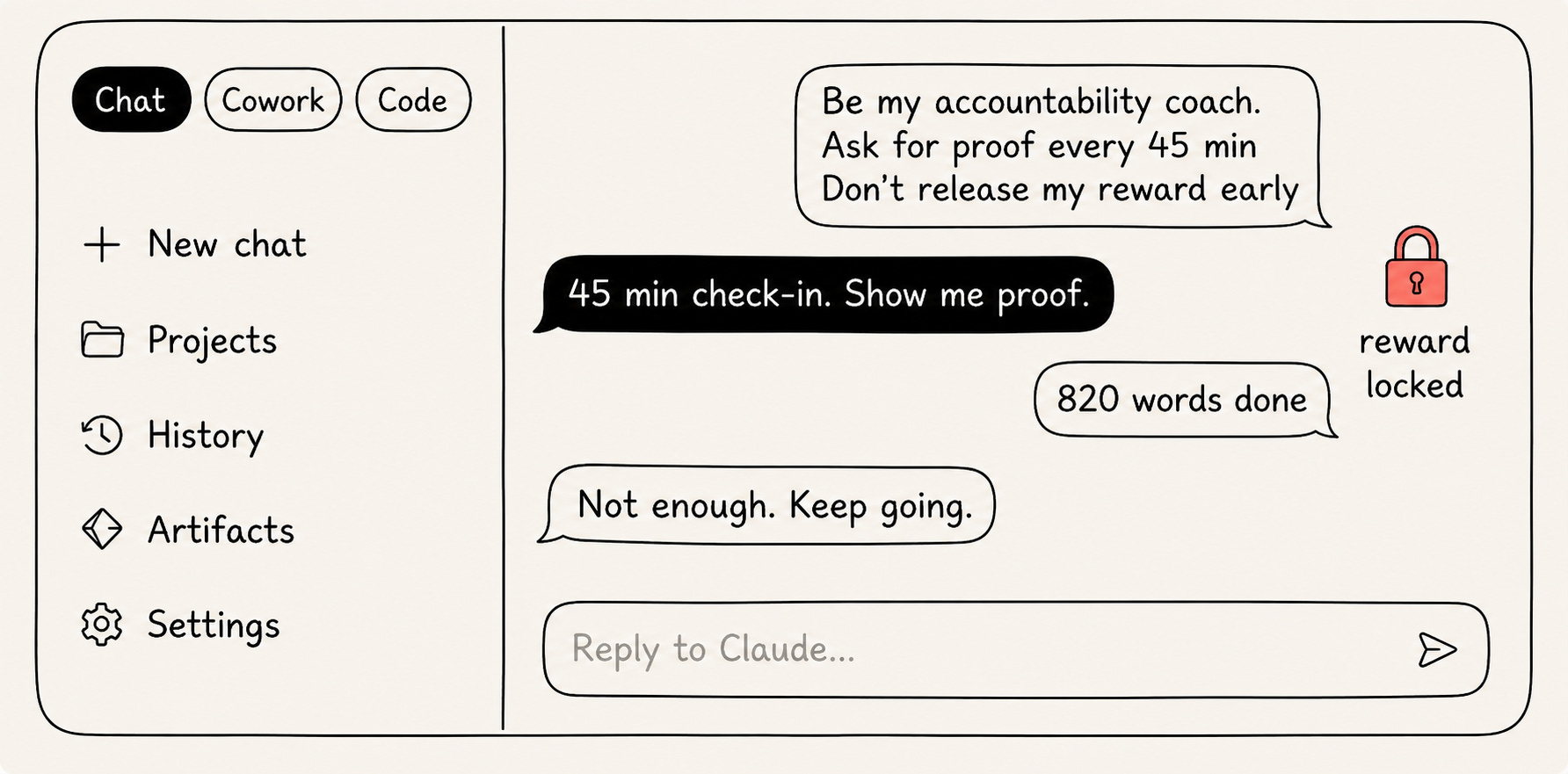
Your brain chases rewards and avoids effort. So put the effort between two things it wants: small reward, hard task, bigger reward. Most people fail because they hand themselves the second reward anyway. Nobody’s checking.
Purpose: make AI the one who checks, so the second reward stays conditional.
Act as my accountability coach for the next 4 hours.
Task: [X] | Small reward before: [Y] | Bigger reward after: [Z]
Ask me for proof of progress every 45 minutes, not a status update.
Proof means pasted output, a word count, or a photo description. Nothing else counts.
If I have not shipped anything, say so plainly and do not accept the excuse.
Keep every check-in under 3 lines and never release [Z] early.
An AI coach beats a human one at 6 AM: it’s awake, it never gets bored of you, and it has no social reason to let you off the hook. Permit it to be blunt, and it will be.
WHAT PAID MEMBERS WILL GET
The four strategies below this line:
Turn the task into something you want to open
Reframe the task as an experiment
Have AI talk to you as the person you are becoming
Use AI to protect your beginner status
Plus full prompt kit - copy-paste ready, the ones I run every morning.
You have the three that get you moving. These four are what keep you moving.
