

You finally got access to Fable 5. The most powerful AI model ever released to the public.
The one the US government literally shut down for three weeks because it was too capable.

You opened Claude. Picked Fable 5. Asked one question.
And 20 minutes later, your usage limit was gone.
Fable 5 burns through your limits roughly 2x faster than anything you’ve used before - and most of that burn is happening in places you’ve never thought to check.
I spent a week tracking where the waste goes. Most of my usage wasn’t going to my actual prompts. It was being eaten alive by invisible overhead.
Today: the 8 drains and the exact fix for each one. No coding. No technical background. Just things you change in your next session.
By the end of this issue, you will get a “Fable 5 Token Survival Checklist” you can download and use before every session. It’s a Notion-ready doc with all 8 fixes in a copy-paste format so you never waste a session again.
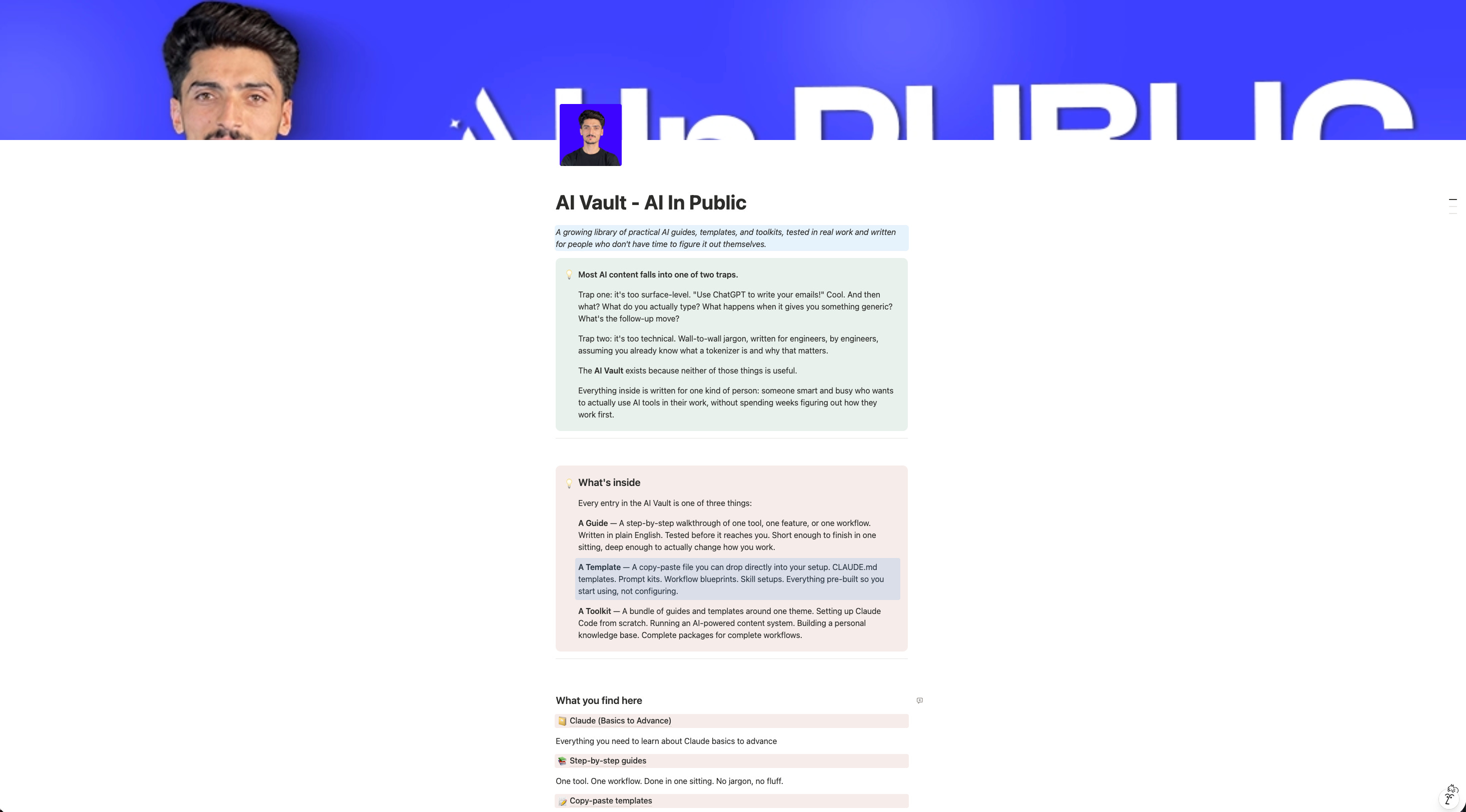
THE AI VAULT IS OPEN
Every guide, kit, template, and prompt library I’ve built - in one place. Organized. Searchable. Growing every week. Here’s how access works:
Paid Members: Get one specific guide related to the newsletter from the Vault every issue. Yours for a week.
Founding Members: Full access to everything inside the Vault. Every guide. Every kit. Every drop. Forever.
We’re 2-3 months away from 10K+ subscribers. The moment we hit that number, we’re launching a private free community - exclusively for AI In Public readers.
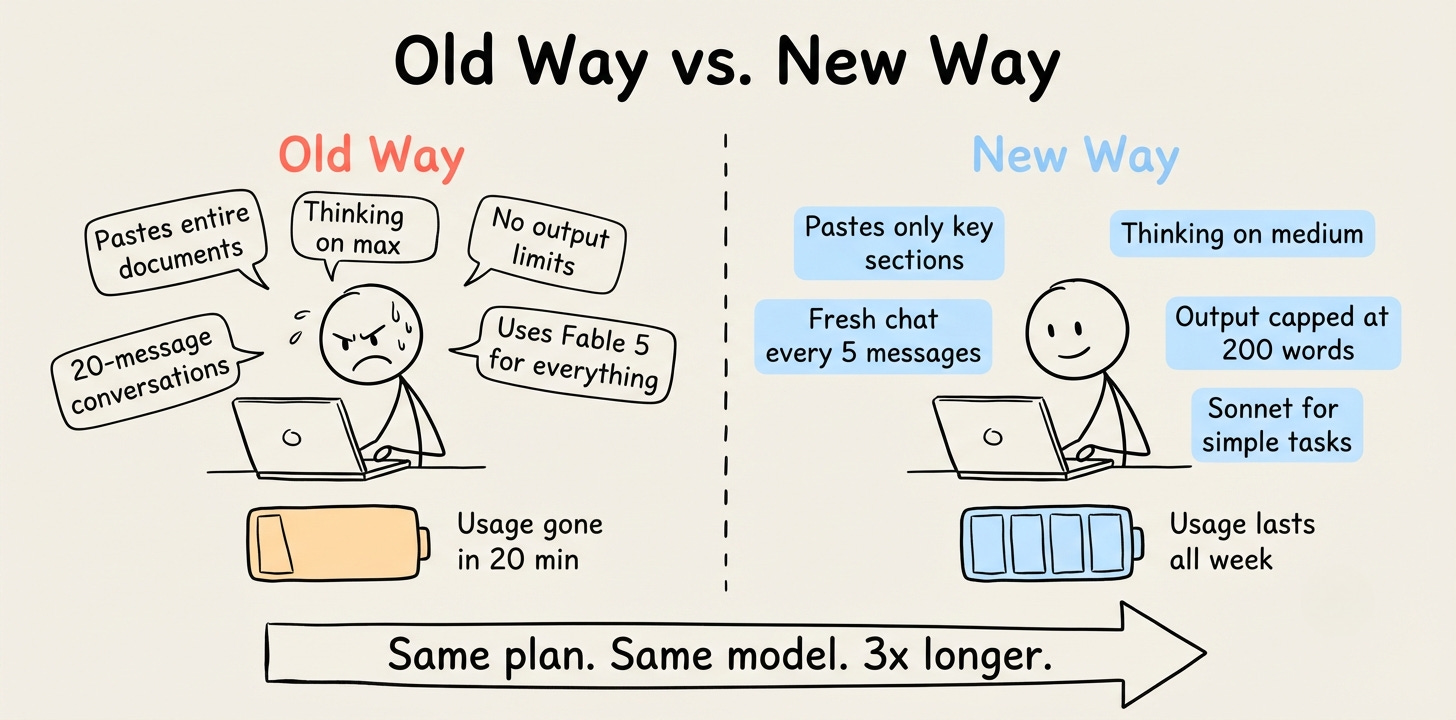
Fable 5 came back online on July 1st. Like everyone else, I was excited.
I switched my Claude model to Fable 5 and started using it for my normal workflow - writing newsletters, brainstorming content, testing prompts.
Within 45 minutes, I got the message: “You’ve reached your usage limit.”
I stared at it. I’d barely done anything. So I started digging.
I looked at how Fable 5 actually works under the hood.
I read every thread on Reddit and Hacker News where people were complaining about the same thing.
And the pattern was clear. Everyone was blaming Anthropic.
Everyone was saying “Fable 5 is too expensive.”
But the real problem wasn’t the model. It was how we were using it.
Transformation Promise
By the end of this issue, you’ll go from “Why does Fable 5 run out so fast?” to “I know exactly where my tokens go - and I’ve fixed the 8 things that were draining them.”
You won’t need to code anything.
You won’t need to understand APIs.
You’ll need to change how you set up your sessions.
This is the difference between someone who complains about usage limits and someone who makes the same plan last 3x longer.
Here’s what the numbers actually look like:
Fable 5 costs $10 per million input tokens and $50 per million output tokens. That’s roughly double what Opus costs.
But the real damage isn’t the per-token price. It’s the invisible multipliers.
The system prompt alone eats ~30,000 tokens before you type a single word. That’s the hidden instruction set Claude loads behind the scenes - 17,000+ words across 72 sections. You never see it. But you pay for it on every message.
Extended thinking can drain your entire 5-hour window in 8 minutes. One Max plan user reported this exact scenario - Fable 5’s internal reasoning trace consumed tokens against their limit even though the user never saw the thinking.
One agentic task can spawn 4-6 parallel model calls. Each one runs its own context. One coding session. Six simultaneous token burns.
This isn’t theory. These are documented cases from the community. And once you see where the waste is, the fixes are embarrassingly simple.
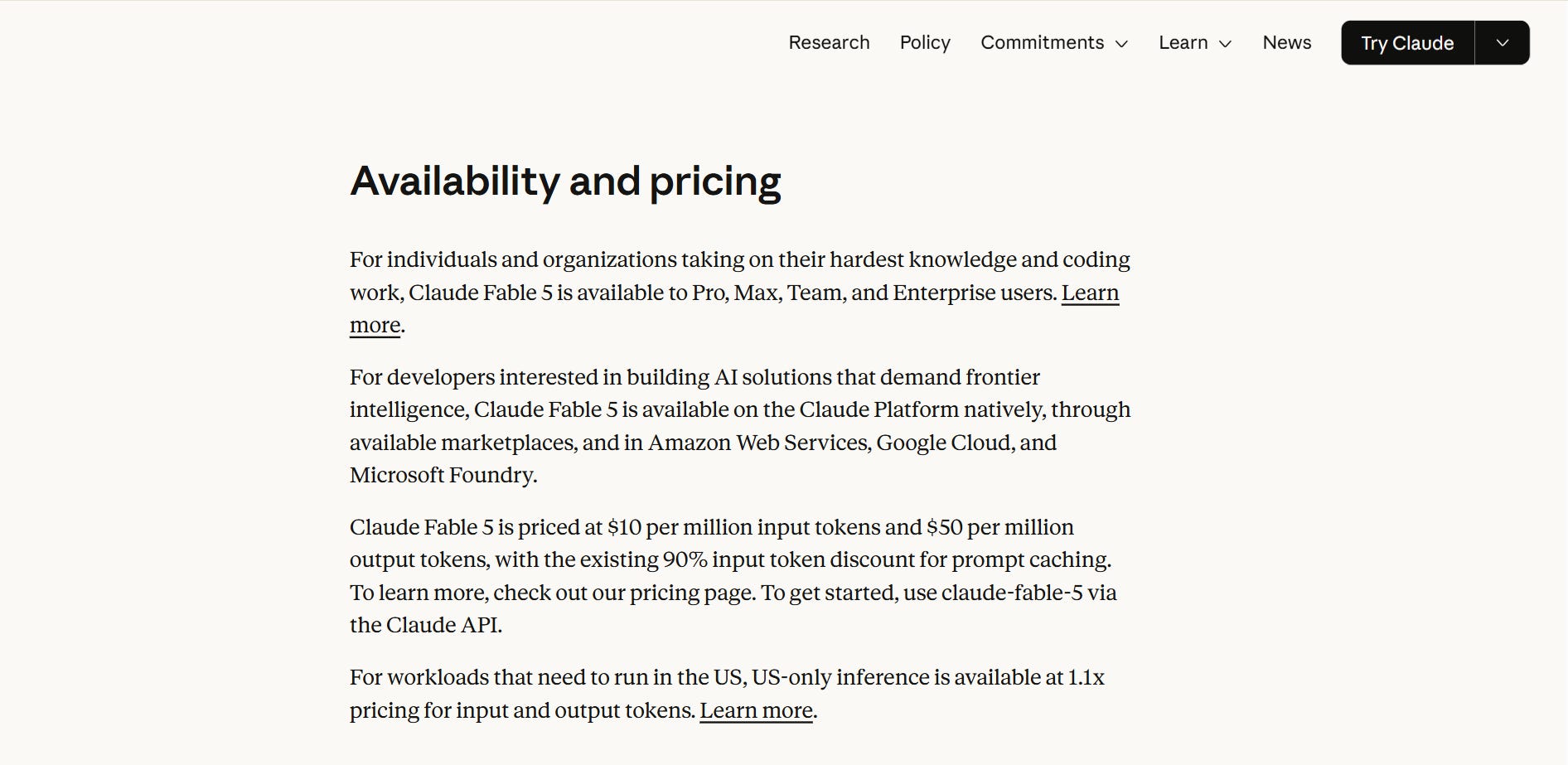
Old Way vs New Way
Old way: Open Fable 5. Paste your question. Hit enter. Wonder why you ran out in 20 minutes. Blame Anthropic. Switch back to Sonnet.
New way: Open Fable 5. Apply the 8 fixes. Get 3x more usage from the same plan. Actually, use the most powerful AI model in the world instead of being afraid of it.
Step-by-Step Walkthrough
Drain #1: You’re Using Fable 5 for Everything
Not every task needs the most powerful model in the world.
Fable 5 is a race car. You don’t take a race car to buy groceries.
If you’re asking Claude to summarize an email, rewrite a paragraph, or brainstorm a list, Sonnet handles that just as well. And it costs a fraction of the tokens.
The fix: Only switch to Fable 5 when you need deep reasoning, complex analysis, or multi-step problem solving. Use Sonnet for everything else. You can switch models mid-conversation in Claude - click the model selector at the top.
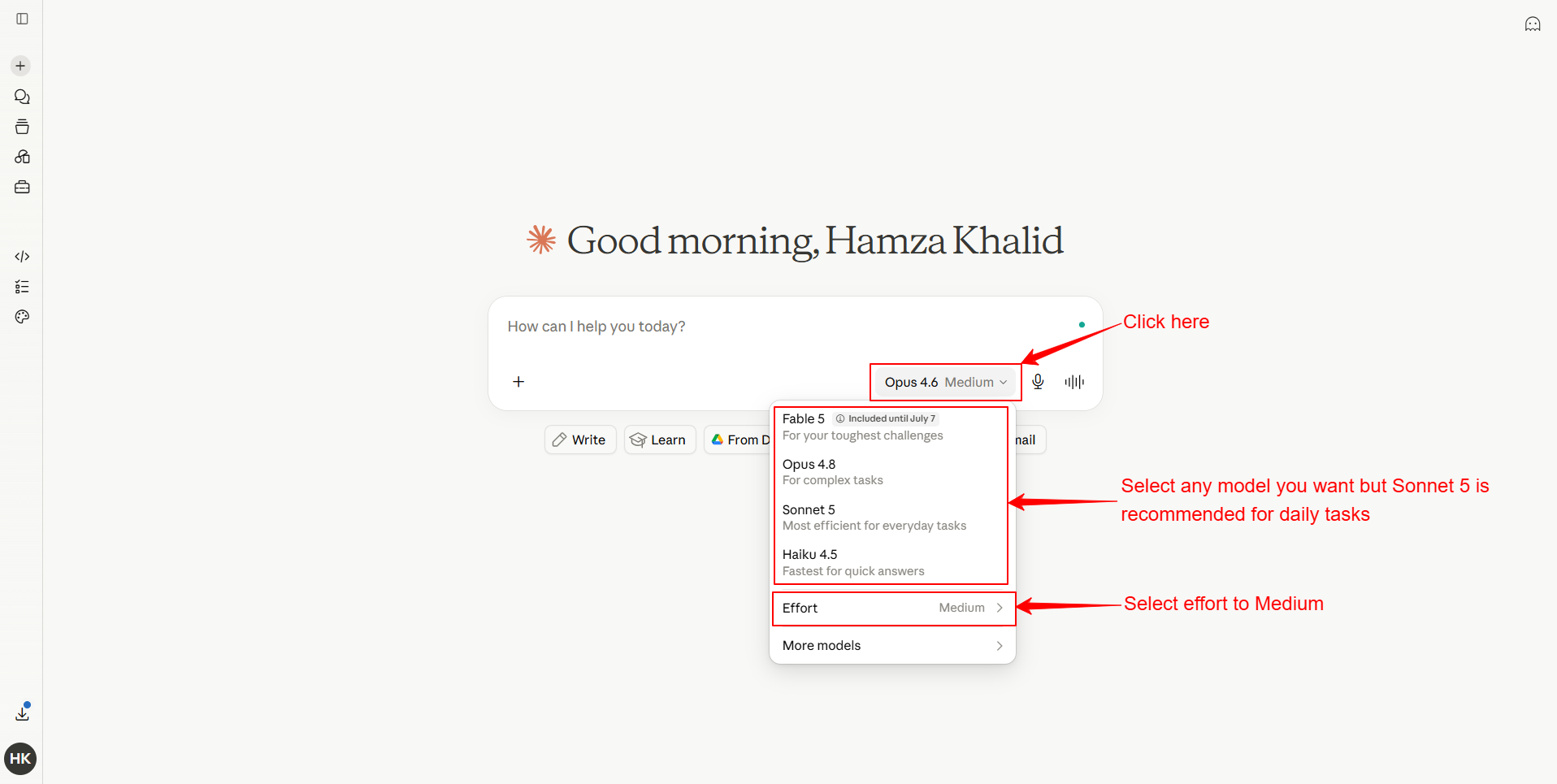
This one decision alone will cut your Fable 5 burn in half.
Drain #2: Your Conversations Are Too Long
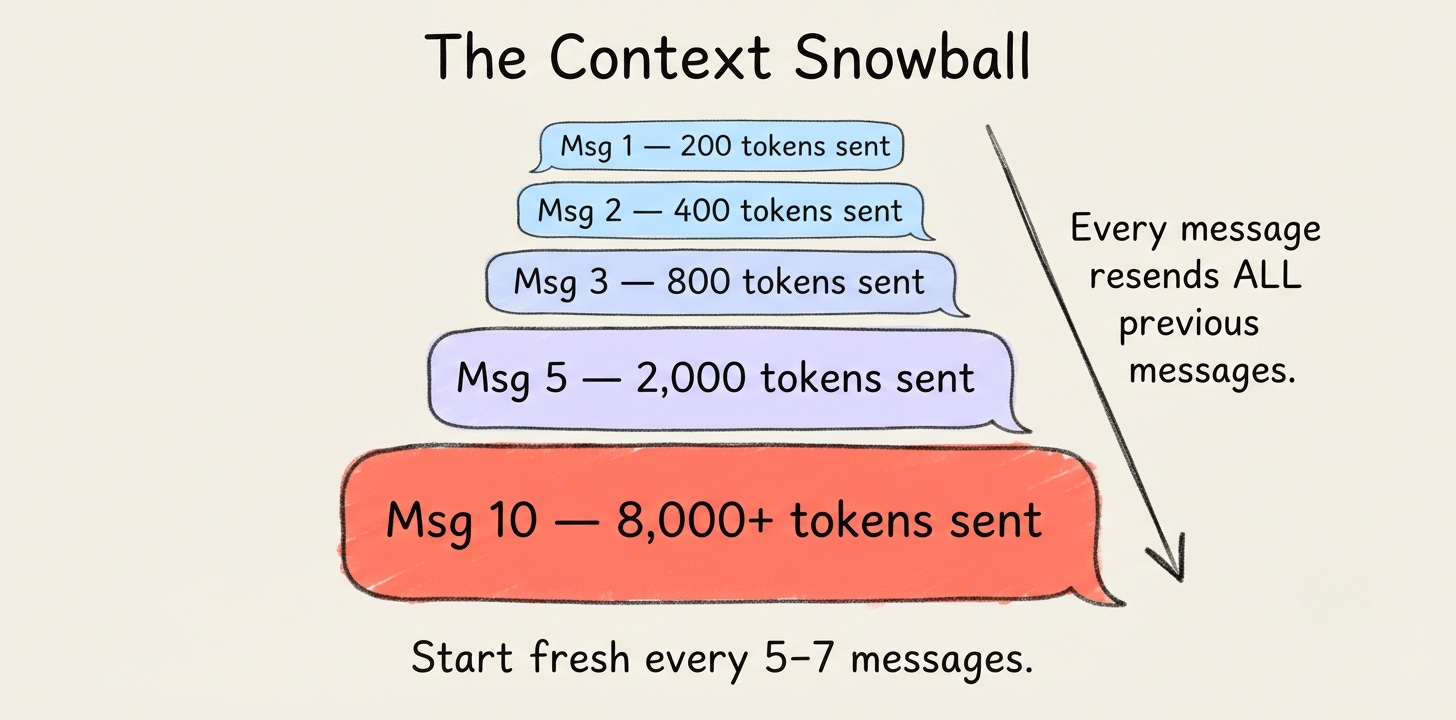
Every message in a conversation gets resent to the model.
Message 1 gets sent once.
Message 2 gets sent with message 1 attached.
Message 10 gets sent with all 9 previous messages attached.
By message 10, you’re sending thousands of tokens of old conversation every single time.
With Fable 5’s pricing, that old context is burning through your limit fast.
The fix: Start a new conversation every 5-7 messages. If you need context from the old conversation, copy the key points into your new first message. Don’t let old conversations snowball.
Drain #3: Extended Thinking Is Eating You Alive
Fable 5 has an internal “thinking” process.
When it’s set to maximum, the model generates a massive reasoning trace before giving you an answer.
You never see this thinking. But you pay for every token of it.
This is the single biggest invisible drain.
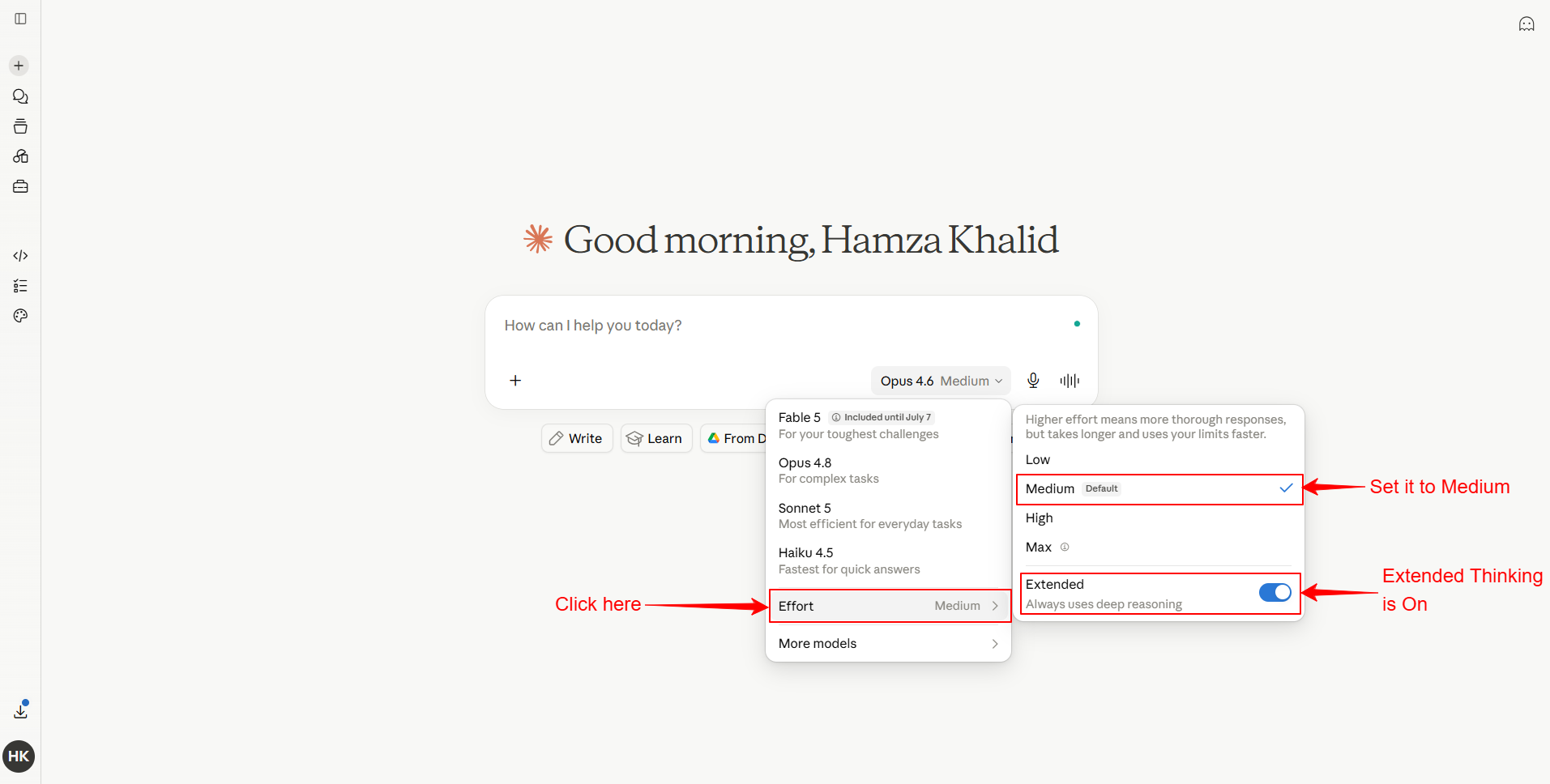
One user burned through their entire 5-hour usage window in 8 minutes because thinking was set to maximum.
The fix: Lower your thinking effort. In Claude, you don’t always need the model to think at maximum depth. For most tasks, medium thinking works great. Save maximum thinking for genuinely complex problems - financial analysis, long research, multi-step planning.
Drain #4: You’re Pasting Entire Documents
When you paste a full 20-page PDF or a massive article into Claude, every word of that document becomes an input token.
At Fable 5’s rates, a 20-page document can cost you significant usage - and the model probably only needs 10% of that content to answer your question.
The fix: Before pasting, pull out the specific sections that matter. Instead of pasting an entire report, paste the executive summary and the specific section you have questions about. Tell Claude exactly what you need from the content.
Try this prompt instead of just dumping a document:
Here's the key section from the Q3 report (pages 4-5):

[paste only the relevant section]

Based on this section, what are the three biggest risks mentioned and how should I prepare for each one?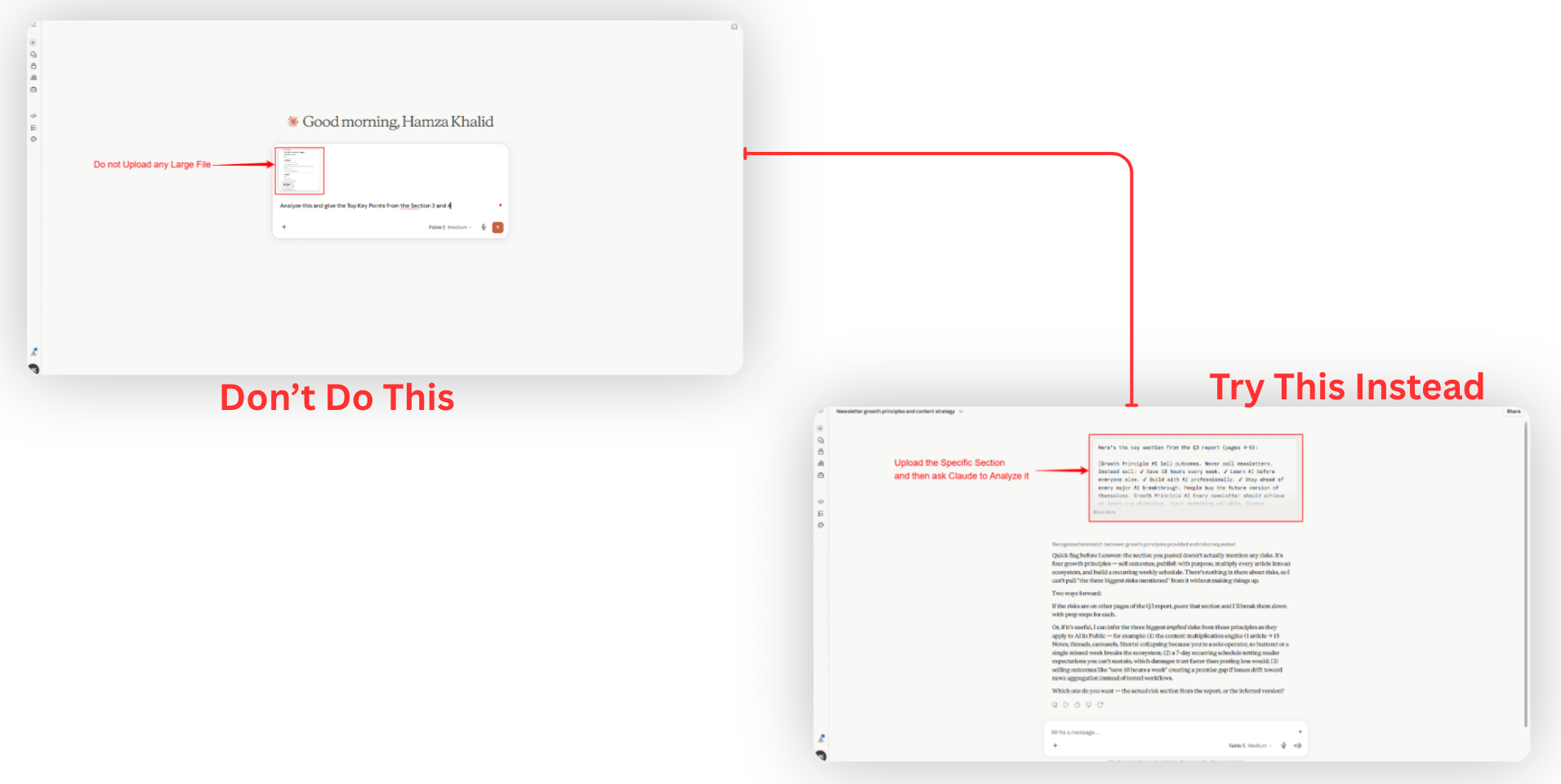
The less you paste, the more Fable 5 can actually think about what matters.
Drain #5: Your System Prompt Is Bloated
If you’re using Claude’s Projects feature or custom instructions, those instructions get loaded into every single message. A 5,000-token system prompt costs you on every exchange.
Most system prompts are full of redundant instructions, repeated context, and paragraphs that could be one sentence.
The fix: Audit your custom instructions. Cut them down to the essentials. A good system prompt for Fable 5 is 500-1,500 tokens. If yours is longer, question every line.
Here’s what a lean system prompt looks like:
You are my business strategist. I run a one-person SaaS company. Revenue: $8K MRR. Target: $15K MRR by Q4. I prefer direct answers. Skip theory — give me actions. Keep responses under 300 words unless I ask for more.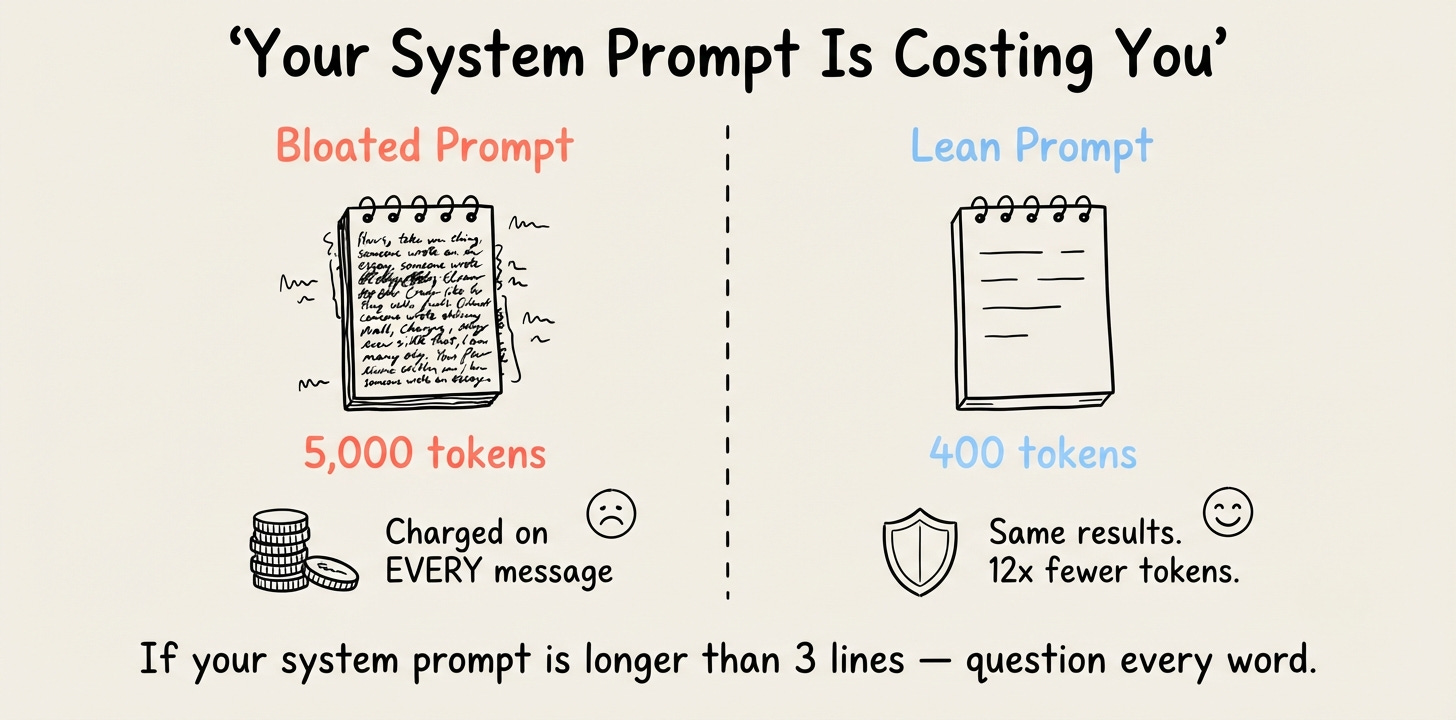
That’s it. Everything the model needs. No bloat. No wasted tokens.
Share this and get rewarded
Go to AI In Public → scroll to the Leaderboard section → copy your referral link → share it with anyone.
Every signup through your link moves you up the board and unlocks real rewards.
At the end of every month, we check the leaderboard.
The top 3 get our best guide - DMed directly, no opt-in required.
Drain #6: You’re Not Telling Claude to Be Concise
By default, Fable 5 is generous with its output.
It explains, contextualizes, adds caveats, and offers alternatives.
That’s great for complex questions.
But for most tasks, you’re paying for 500 words when you needed 100.
Remember - output tokens cost 5x more than input tokens.
Every unnecessary word in Claude’s response costs you five times what it costs to send your prompt.
The fix: Add output constraints to your prompts. Tell Claude exactly how much you need.
Give me a 3-sentence summary. No caveats. No alternatives. Just the answer.Or:
Answer in under 100 words. Be direct.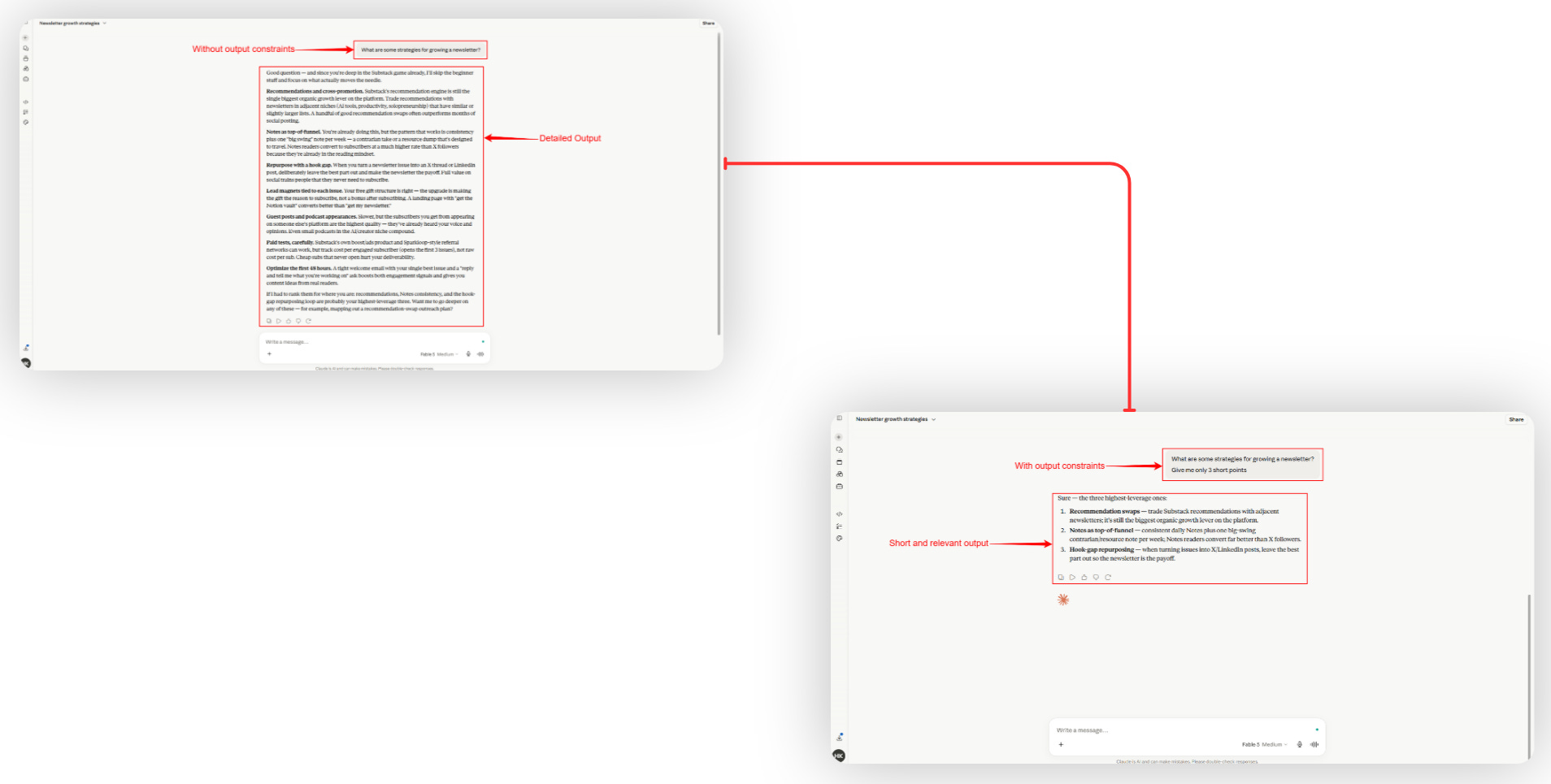
This line saves you more tokens than any hack.
Drain #7: You’re Re-Explaining Context Every Message
If you tell Claude your background in message 1, you don’t need to repeat it in message 3.
But most people do - either by restating their situation or by asking questions that force Claude to re-read everything.
The fix: Front-load your context in the first message. Make it specific. Then reference it in follow-ups without repeating it.
First message:
I run a newsletter with 5,000 subscribers. I'm trying to convert 2% to paid. My current price is $8/month. I've tried a free gift strategy and it got 47 conversions last month.Follow-up messages:
Based on what I shared, should I increase price to $10 or add a second tier?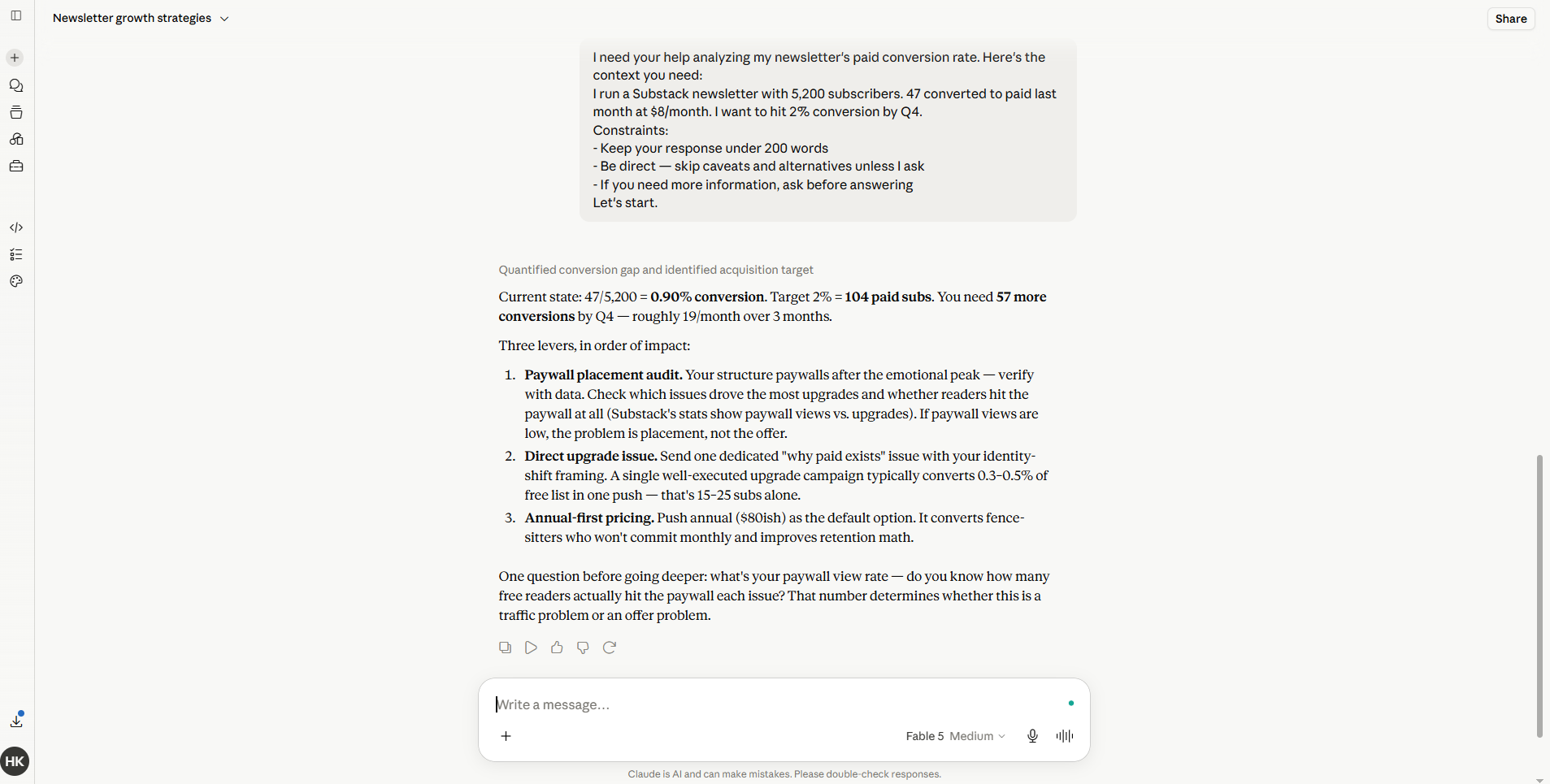
Not:
So I have this newsletter with about 5,000 subscribers and I'm trying to get more paid members. My price is $8/month and I tried a free gift thing that got some conversions. Should I raise my price?The first version references existing context. The second version re-sends it. With Fable 5, that difference matters.
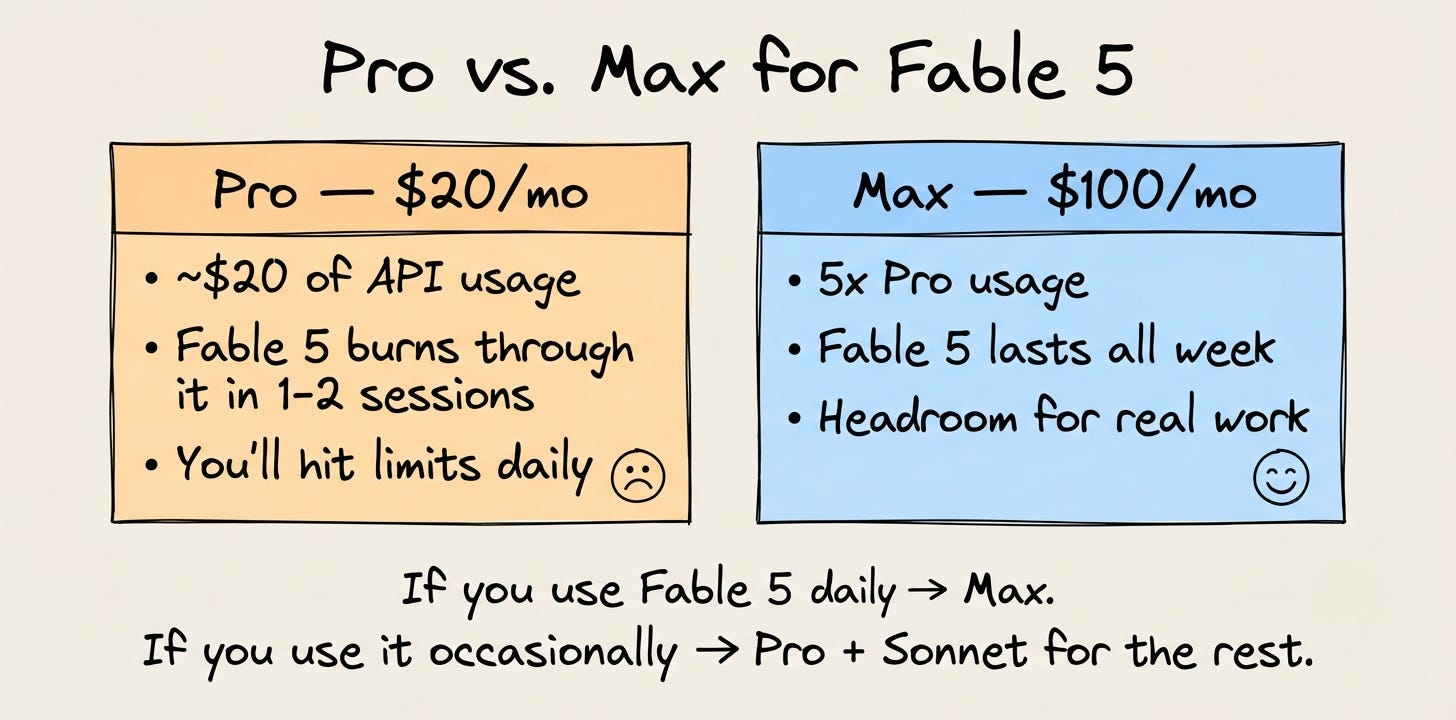
Drain #8: You’re Not Using the Right Plan for Your Usage
Most people on the Pro plan ($20/month) hit Fable 5 limits almost immediately.
That’s because Fable 5 burns through Pro limits roughly 2x faster than Opus.
Your $20 plan gives you roughly $20 worth of API-equivalent usage - and Fable 5 eats that in a few sessions.
The fix: Be honest about your usage. If you’re using Fable 5 regularly, the Max plan ($100/month) gives you 5x the Pro limit. That’s the difference between running out every day and having headroom all week. If you only need Fable 5 occasionally, stay on Pro but switch to it only for the tasks that actually need it. Use Sonnet for everything else.
The 30-second session setup that saves 80% of your tokens:
Before every Fable 5 session, ask yourself three questions.
Is this task complex enough for Fable 5, or can Sonnet handle it?
Is my context lean - only the information Claude actually needs?
Did I set output constraints so Claude doesn’t over-explain?
If the answer to all three is yes, you’re ready. If not, fix what’s missing before you start.
Real-World Examples
Example 1: I used Fable 5 to analyze a competitor’s pricing strategy. Old way - I pasted their entire website copy (3,000 words) and asked: “What can I learn from this?” Claude gave me a 1,200-word analysis. New way - I pasted just their pricing table and one testimonial, asked for “3 specific things I should steal for my own pricing page, under 150 words.” Got exactly what I needed. Used about 70% fewer tokens.
Example 2: I used Fable 5 to improve a newsletter draft. Old way - I pasted the full 2,500-word draft and asked for feedback. Claude rewrote half of it (massive output tokens). New way - I pasted just the intro and asked, “Is this hook strong enough? Yes or no, and if no, give me one alternative.” Targeted. Lean. Effective.
Let me slow down here.
The real lesson isn’t about saving tokens.
It’s about being intentional with powerful tools.
Fable 5 is the most capable AI model most of us will ever use. But more power doesn’t mean you should use it carelessly. The people who get the most out of Fable 5 aren’t the ones who throw everything at it and hope for the best. They’re the ones who know exactly when to use it, what to feed it, and how much to ask for.
That’s not just a token strategy. That’s a life strategy.
Be precise about what you need. Cut the noise. Get the answer.
Recap Checklist
Here’s your 8-fix checklist. Apply all of these before your next Fable 5 session:
Only use Fable 5 for complex tasks. Sonnet handles the rest.
Start new conversations every 5-7 messages. Don’t let context snowball.
Lower your thinking effort. Maximum thinking isn’t always needed.
Stop pasting entire documents. Pull the specific sections you need.
Audit your system prompt. Get it under 1,500 tokens.
Add output constraints to every prompt. Tell Claude how much you need.
Front-load context once. Reference it — don’t repeat it.
Match your plan to your usage. Pro limits + Fable 5 = frustration.
Upgrade to keep reading
The free version of this newsletter gets you the what.
Paid members get the how, in detail.
Every issue comes with a resource that took me hours to build and takes you 10 minutes to use.
Paid Members: One hand-picked AI Vault guide every issue, chosen for what we covered today.
Founding Members: Full AI Vault access. Every guide. Every kit. Forever. Plus, first access to the private community at 10K subscribers.
Everything above is free. What’s below is for paid subscribers.
