

Your Obsidian vault isn’t a second brain.
It’s a cemetery.
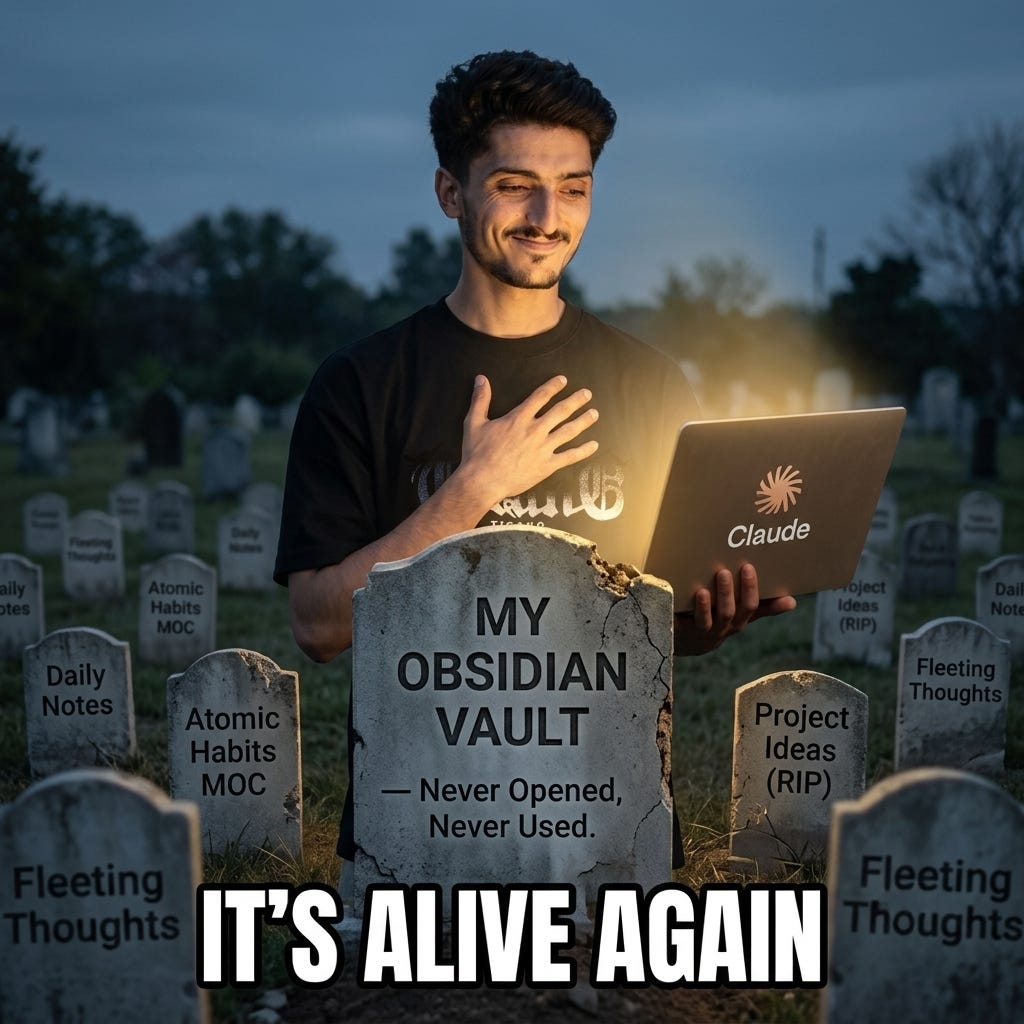
You know it. You’ve felt it. You open it, see 400 orphaned notes (notes with no connections) staring back at you, and quietly close the app. You tell yourself you’ll “organize it later.”
Later never comes.
I spent 6 months building a vault I never used. Then I spent one afternoon with Claude fixing it all.
You're the reason this newsletter exists. What AI tool or workflow should I test next? Drop your topic in the comments - the most-requested one becomes the next issue.
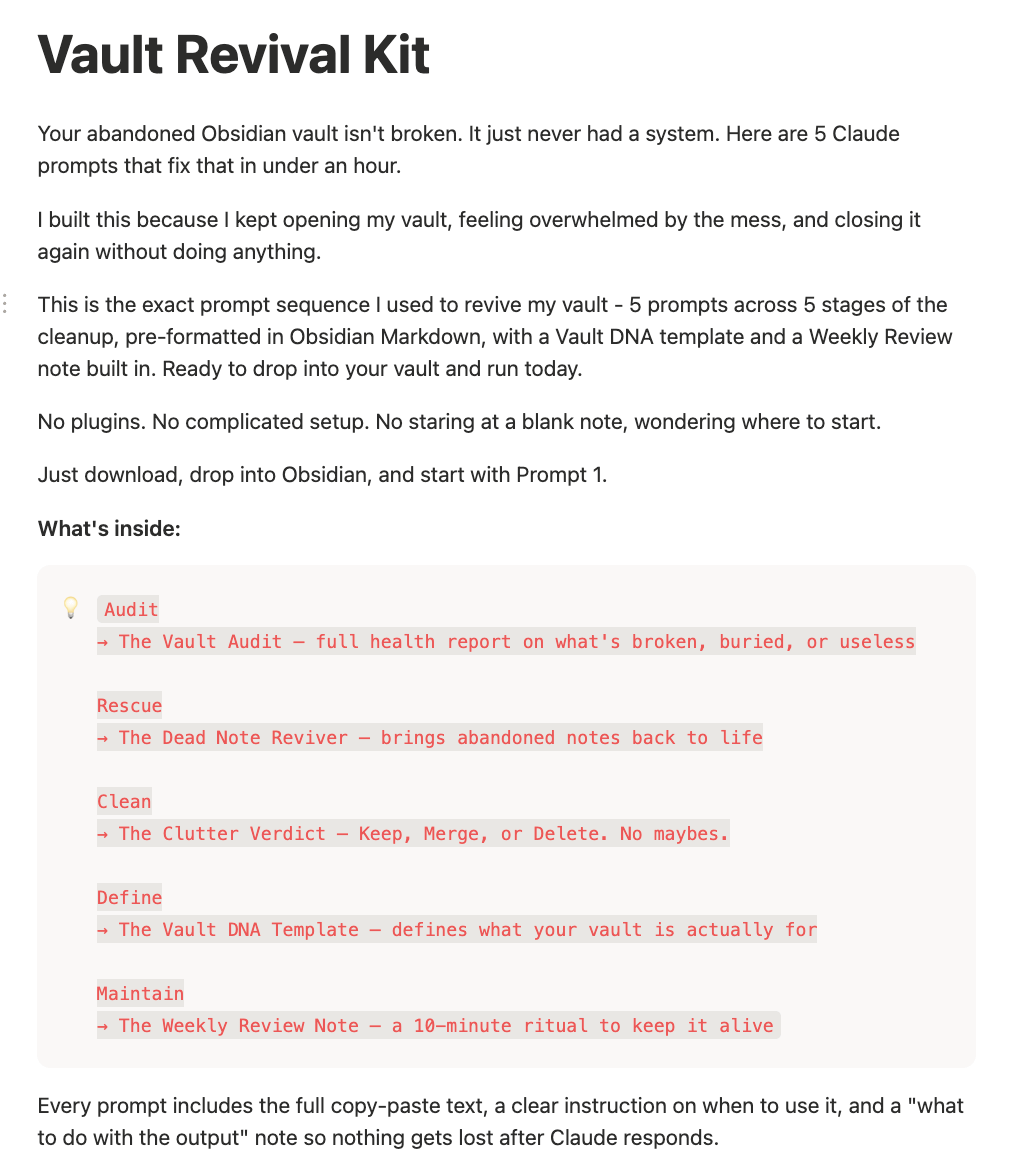
By the end of this issue, you’ll get a copy-paste Claude prompt kit, 5 prompts that revive any dead vault in under 2 hours. No plugins. No setup.
Three months ago, I had 2,000+ notes in Obsidian.
I couldn’t find anything. I had 12 folders that made sense when I created them and zero sense now.
I had notes titled “Idea 1”, “Untitled 47”, “Follow up - important!!!” with no context attached.
The graph view looked impressive. It meant nothing.
I was collecting knowledge like a hoarder collects newspapers. The pile kept growing. Nothing was ever used.
If you’ve ever felt that quiet guilt of opening Obsidian and immediately closing it, this issue is for you.
Then I asked Claude to help me audit the whole thing. Not organize it. Audit it. That one word changed everything.
The real problem nobody talks about
Here’s what the productivity YouTubers won’t tell you.
Your vault didn’t fail because you picked the wrong system.
It didn’t fail because you’re undisciplined.
It didn’t fail because Notion would have been better.
It failed because every second brain system is designed for input. None of them is designed for output.
“If this is useful, share it with one person building on YouTube. Takes 10 seconds and it might save them weeks.”
The old way vs the new way
Old way: Create folder → Add note → Forget note → Create another folder → Feel guilty → Restart vault → Repeat.
New way: Audit with Claude → Find real patterns → Rebuild around retrieval → Maintain with 10 minutes a week.
The old way demands maintenance before it gives you value.
The new way gives you value first. Maintenance follows naturally.
If you know someone who’s abandoned their Obsidian vault, send them this. It might be the thing that finally fixes it.
Here’s the complete Step-by-Step Guide
Step 1: Run the Vault Autopsy
Before you fix anything, you need to know what’s actually broken.
Most people skip this. They open Obsidian, feel overwhelmed, and start reorganizing by gut feeling. That’s how you waste 4 hours moving notes between equally useless folders.
The Vault Autopsy is different. You give Claude a sample of your worst notes and ask him to diagnose the system, not fix it yet. Just diagnose. Like a doctor who runs tests before prescribing.
Quick setup:
Open Obsidian and go to your most chaotic folder
Copy the titles of 30–50 notes (just titles, not content)
Open Claude and paste the prompt below
I have an Obsidian vault with a serious organization problem.
Here are 50 note titles from my most disorganized folder:

[paste your note titles here]

Analyze these titles and tell me:
1. What are the 3 core themes hiding in this list?
2. Which notes are clearly orphaned (no obvious home)?
3. Which titles suggest duplicate content I probably have?
4. What does this list tell you about how I actually think and work?

Be direct. Don't soften it. I need an honest diagnosis.“‘Be direct. Don’t soften it.’ - this line does all the work. Without it, Claude gives you a polite list. With it, you get a real diagnosis you can act on.”
What you’ll get: 3–5 real patterns in your thinking that your folder structure never captured.
I ran this, and Claude found that 70% of my “random” notes were actually about content systems, a topic I thought I barely wrote about. My vault had a whole brain of content knowledge I never knew I had.
That discovery alone was worth the afternoon.
This is your foundation. Don’t rush it. Every step that follows builds on what Claude finds here.
